
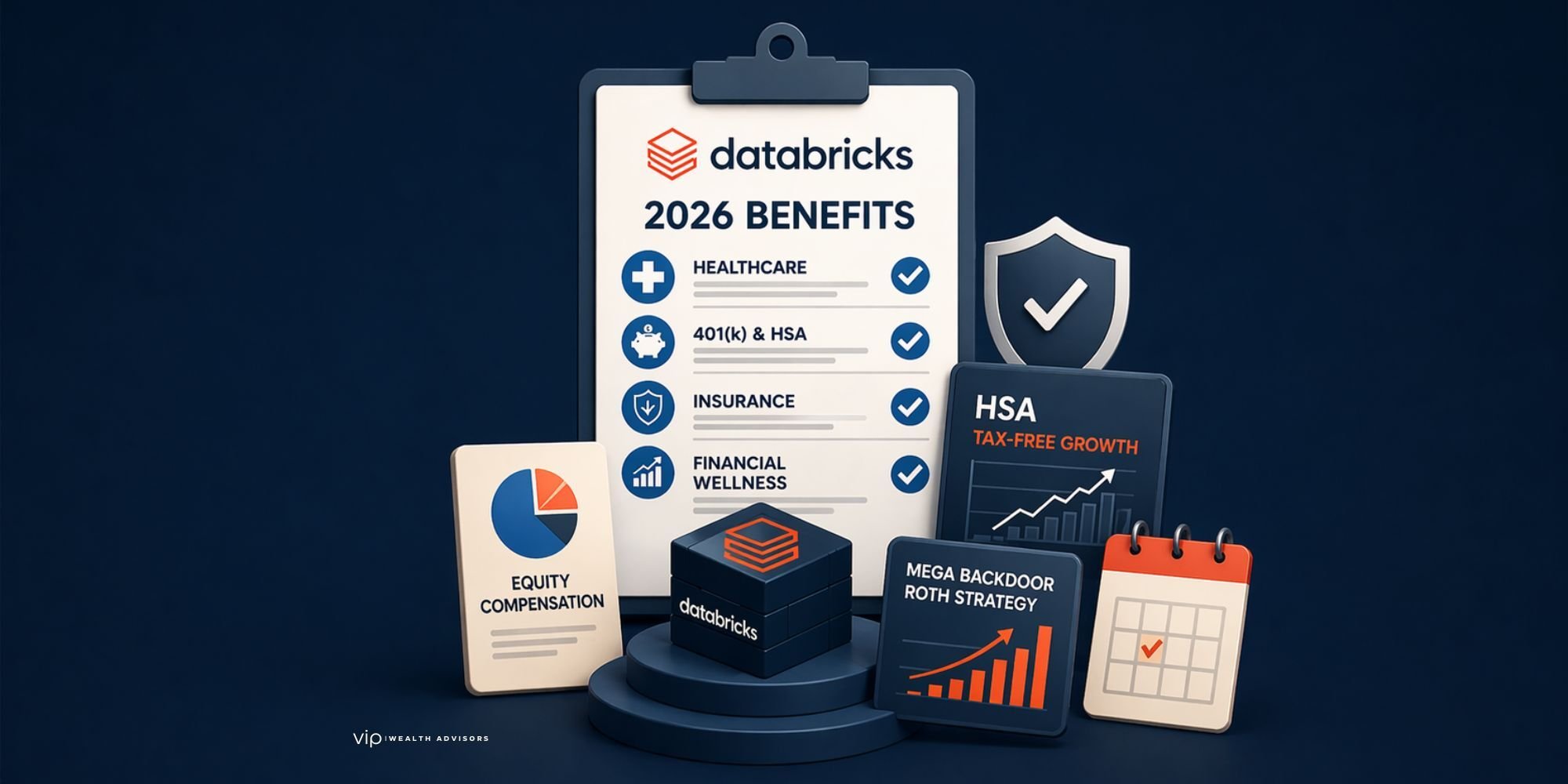
Databricks employees can turn the 2026 benefits package into a tax, wealth-building, and risk-management strategy when they coordinate healthcare, HSAs, retirement contributions, insurance, and equity compensation.
Key Takeaways
- The 2026 switch to Anthem Blue Cross means Databricks employees should re-evaluate medical plan choices instead of defaulting to last year’s election.
- The HDHP may be more valuable for high earners when paired with max HSA contributions and long-term investing.
- The Databricks 401(k) plan may support Mega Backdoor Roth planning through after-tax contributions and in-plan Roth conversions.
- Benefits like Carrot, Modern Health, Wellthy, life insurance, and disability insurance can become meaningful planning tools when used proactively.
- The biggest opportunity is coordinating benefits with RSUs, stock options, bonuses, taxes, and long-term wealth strategy.
If you work at Databricks, your benefits package isn’t just a checklist during open enrollment.
It’s a financial toolkit.
And if you’re a high earner with equity compensation, multiple income streams, or a growing net worth, how you use that toolkit can materially impact:
- how much you pay in taxes
- how efficiently you build wealth
- how protected you are if something goes wrong
- and how flexible your future becomes
Employees frequently treat benefits like paperwork.
The ones who understand them? They use them as leverage.
Let’s break down what actually matters inside the 2026 Databricks benefits package - and where the real planning opportunities are hiding.
What Changed for 2026 (And Why It Matters More Than You Think)
The headline change is the shift from UnitedHealthcare to Anthem Blue Cross for U.S. employees.
On paper, it looks like a standard carrier swap. In reality, it changes how you should evaluate your entire healthcare strategy.
Key upgrades include:
- Lower coinsurance levels on PPO and HDHP plans
- Lower PPO deductible and out-of-pocket maximums
- Increased Databricks HSA contributions to offset HDHP changes
- Expanded support through Anthem advocates and care coordination
This is not a “set it and forget it” year.
If you’re in the middle of treatment, have specialists, or are optimizing for long-term wealth (not just convenience), you should carefully re-evaluate your plan choice.
PPO vs. HDHP: This Decision Is Bigger Than It Looks
Employees tend to default to PPO because it feels ‘safer’ - not because it’s actually better.
But high earners often benefit more from thinking differently.
The PPO:
- Predictable costs
- Lower deductible
- Higher premiums
The HDHP:
- Higher deductible
- Lower premiums
- Access to an HSA (this is the key)
Comparing these purely on annual medical costs.
Which plan creates the best long-term financial outcome?
Because once you factor in the HSA, the answer often flips.
The HSA: Your Most Versatile Tax Shield
If you elect the HDHP, Databricks contributes up to:
- $1,190 (individual)
- $2,380 (family)
And you can contribute up to the IRS limits:
- $4,400 (individual)
- $8,750 (family)
Employees tend to treat their HSA as a short-term checking account.
That’s a mistake.
The real strategy:
- Contribute the maximum
- Invest the balance
- Pay medical expenses out-of-pocket
- Let the HSA grow tax-free for decades
Why?
An HSA is the only account with a triple tax advantage, making it more efficient than a 401(k) or IRA for medical wealth-building:
- Tax-free contributions
- Tax-free growth
- Tax-free withdrawals (for qualified expenses)
At age 65, it even behaves like a traditional IRA if used for non-medical expenses.
If you’re in California, HSAs lose some of their tax advantages at the state level.
That doesn’t kill the strategy. But it does mean you need to be more intentional.
The Databricks 401(k): Where the Real Opportunity Lives
This is where things get interesting.
The Databricks plan includes:
- Pre-tax contributions
- Roth contributions
- After-tax (non-Roth) contributions
- In-plan Roth conversions (via Fidelity)
That last combination is what unlocks the strategy employees miss:
The Mega Backdoor Roth
Here’s the simplified version:
- You max out your standard 401(k) ($24,500 range)
- You contribute additional after-tax dollars
- You convert those dollars into a Roth (often immediately)
The plan allows after-tax contributions up to $47,500 total (subject to limits)
Why this matters:
- You can potentially move tens of thousands per year into a Roth
- Future growth becomes tax-free
- This is one of the most powerful long-term tax strategies available
- Not knowing the feature exists
- Leaving after-tax money unconverted (creating tax drag)
- Not coordinating with RSUs or other taxable income
- Overfunding without understanding cash flow implications
This alone is a strong reason for a more strategic approach to benefits.
Carrot: Maximizing the $15,000 Benefit Before It Becomes Urgent
Databricks offers a $15,000 lifetime benefit through Carrot for:
- Fertility treatment
- Egg/sperm/embryo freezing
- IVF
- Adoption and surrogacy
- Pregnancy and postpartum support
- Menopause and hormonal care
This is a serious benefit. The unfortunate reality is that employees neglect to investigate these options until they are facing significant pressure.
The better approach:
Understand it early, especially if you are:
- delaying having children
- unsure about future family plans
- in a dual-career household
- considering alternative family-building paths
There are also rules around:
- when you must be enrolled in a Databricks medical plan
- how reimbursements work
- what counts toward the lifetime maximum
This is one of those benefits that becomes far more valuable with proactive planning.
Mental Health and Family Support: Quietly Elite Benefits
Databricks provides access to:
Modern Health
- Coaching and therapy
- 13 coaching sessions + 12 therapy sessions per year
- Coverage extends to dependents
Employee Assistance Program (EAP)
- 24/7 support
- Up to 5 sessions per issue
- Coverage for financial, legal, and life challenges
Wellthy
- Care coordination for:
- aging parents
- childcare
- medical conditions
- mental health
- Includes backup care support
These aren’t just “nice perks.”
They reduce stress, protect productivity, and indirectly support your financial life.
Yet, these resources often remain significantly underutilized.
Insurance: Where High Earners Can Get Caught Off Guard
Databricks provides strong baseline coverage:
Life Insurance
- 1.5x salary up to $750,000
Disability Insurance
- Short-term: 66.7% income (up to $3,500/week)
- Long-term: 66.7% income (up to $15,000/month)
This is solid.
But here’s the issue for high earners:
If you earn:
- $500K
- $800K
- $1M+
Your actual income replacement ratio may be much lower than expected.
Common blind spots:
- Bonuses and equity often aren’t fully covered
- Benefits may be taxable depending on the structure
- Long-term disability may not fully protect lifestyle
This is where high earners are unintentionally underinsured.
Common Mistakes Databricks Employees Make During Enrollment
Let’s be blunt. These happen every year:
1. Defaulting without reviewing changes
Especially dangerous in a transition year like 2026.
2. Ignoring the HSA opportunity
Treating it like a spending account instead of an investment tool.
3. Not using the Mega Backdoor Roth
Or using it incorrectly.
4. Choosing PPO out of habit
Without running the numbers.
5. Overlooking insurance gaps
Assuming employer coverage is “enough.”
6. Not coordinating benefits with equity comp
This is a big one for Databricks employees.
Your benefits don’t exist in a vacuum. They interact with:
- RSUs
- stock options
- bonuses
- tax planning
Ignoring that connection is costly.
The Real Takeaway
Databricks offers a strong benefits package.
But the value is not in the benefits themselves.
It’s in how you use them.
A high-earning employee who:
- maximizes the HSA
- properly executes the Mega Backdoor Roth
- chooses the right medical plan
- understands insurance gaps
- coordinates everything with equity compensation
…is playing a completely different game than someone who just checks boxes during open enrollment.
That gap compounds over time.
Beyond the Checklist: Your Wealth, Your Strategy
If you’re working at Databricks, you’re likely operating at a high level professionally.
Your financial decisions should match that level.
Don’t treat your benefits like paperwork.
Treat them like strategy.
And be bold enough to actually use them that way.
FAQ: Databricks Benefits (2026)
+Is the HDHP worth it at Databricks?
It depends on your health usage and financial goals. For high earners who can afford out-of-pocket costs, the HSA often makes the HDHP more attractive in the long term.
+Does Databricks support a Mega Backdoor Roth?
Yes! And this is a terrific benefit. The plan allows after-tax contributions and in-plan Roth conversions, which can enable this strategy if executed properly.
+How much does Databricks contribute to the HSA?
Up to $1,190 for individuals and $2,380 for families, depending on coverage level.
+What is the Carrot benefit?
A $15,000 lifetime benefit for fertility, family planning, and related services.
+Is employer disability insurance enough?
For many high earners, no. The benefit caps can leave a significant income gap.
+What changed for 2026?
The major change is the switch to Anthem Blue Cross, along with plan design improvements and higher HSA contributions.
Databricks benefits are not paperwork. They are planning opportunities.
If you work at Databricks and have equity compensation, high income, or a growing net worth, your benefits elections should not be made in isolation.
We can help you evaluate your healthcare plan, HSA strategy, Mega Backdoor Roth opportunity, insurance gaps, and equity compensation together so your benefits actually support your bigger financial plan.