

Ordinary rental income generally does not count as earned income for Solo 401(k) or SEP IRA contributions, even when the owner qualifies as a real estate professional and manages the properties full-time.
Key Takeaways
- Real estate professional status can affect passive-loss treatment, but it does not automatically create retirement-plan compensation.
- Ordinary Schedule E rental profit is generally excluded from net earnings from self-employment.
- A disregarded LLC does not change the tax character of ordinary rental income.
- A genuine separate business with qualifying earned income may support a Solo 401(k) or SEP IRA.
- Related entities and employees can trigger common-control and plan-coverage rules that must be reviewed before adopting a Solo 401(k).
Managing rental properties may be a full-time business, but the IRS does not automatically treat rental profits as earned income for a Solo 401(k) or SEP IRA. Here's where the line is drawn, why management-company workarounds demand scrutiny, and what legitimate planning alternatives may exist.
A Full-Time Real Estate Business Doesn't Always Produce Retirement-Plan Compensation
Consider an investor who owns seven residential rental properties. He negotiates leases, screens tenants, coordinates contractors, manages capital improvements, handles emergencies, and keeps the books. Property management is his primary occupation. He logs well over 750 hours a year and meets the IRS requirements to be treated as a real estate professional.
His properties earn $200,000 after operating expenses and depreciation. He has no outside job. He wants to contribute part of the profits to a Solo 401(k), or perhaps establish a SEP IRA.
The time spent managing rental properties does not, by itself, turn ordinary rental profits into the earned income required to support Solo 401(k) or SEP IRA contributions.
This is one of the more counterintuitive intersections of real estate taxation and retirement planning. A property owner can run a sophisticated rental business, qualify as a real estate professional, materially participate in the operations, and still have no compensation eligible for a Solo 401(k) or SEP IRA from the ordinary rental income alone.
The reason is that the IRS uses different standards for passive-activity losses, self-employment taxes, and retirement-plan compensation. Those distinctions matter far more than whether an investor views the rental portfolio as a full-time business.
Three IRS Rules That Landlords Often Confuse
First, real estate professional status under Internal Revenue Code Section 469(c)(7) is primarily a passive-activity concept. Generally, an individual must perform more than 750 hours of qualifying real property services and devote more than half of personal service time in trades or businesses to qualifying real property trades or businesses in which the individual materially participates.
The rules are detailed, and qualifying as a real estate professional does not automatically establish material participation in each rental activity.
Second, rental income is generally excluded from net earnings from self-employment under IRC Section 1402(a)(1). That is why ordinary residential rental profits are typically reported on Schedule E and generally are not subject to self-employment tax.
Exceptions exist, particularly when the operator provides substantial services primarily for the occupants' convenience. Ordinary maintenance, repairs, trash removal, and common-area services do not usually transform residential rentals into a hotel-like service business.
Third, Solo 401(k) and SEP IRA contributions require qualifying compensation or earned income. For a self-employed individual, the relevant definition comes from IRC Section 401(c)(2), which defines earned income as net earnings from self-employment, subject to specific adjustments. Qualifying as a real estate professional under Section 469 does not override that separate earned-income requirement.
Nonpassive does not necessarily mean self-employment income.
The distinction is subtle but consequential: Nonpassive does not necessarily mean self-employment income, and self-employment income is the starting point for retirement-plan compensation.
Does Ownership Through an LLC Change the Answer?
Generally, no. Owning a rental property directly or through a single-member LLC taxed as a disregarded entity does not change the character of ordinary rental income. The federal tax system generally looks through the disregarded entity to the owner.
Creating seven LLCs instead of holding seven deeds personally may serve meaningful liability and administrative objectives, but it does not automatically create retirement-plan compensation.
A multi-member LLC taxed as a partnership is not a shortcut either. Ordinary rental allocations to members generally retain their rental character. Some partner-level guaranteed payments for bona fide services can have different tax treatment, but that requires examining the partnership agreement, actual services, and relevant tax rules.
It is not simply a matter of relabeling distributive rental income.
What About Putting the Rental Properties Inside an S Corporation?
An S corporation also does not magically convert rental distributions into compensation. The pass-through rental income ordinarily does not support retirement-plan contributions merely because it appears on a shareholder's Schedule K-1.
There is an important exception: An S corporation may pay genuine, reasonable W-2 wages to an owner-employee for services actually rendered. Those qualifying wages can support a retirement plan the corporation establishes, provided the plan and employee-coverage requirements are satisfied.
That does not mean an investor should transfer appreciated rental real estate into an S corporation to create wages. Transfers, financing arrangements, liability allocations, exit planning, and the eventual disposition of property can make that choice costly or difficult to reverse.
The corporation must actually operate and pay compensation for legitimate services. The W-2 salary cannot be a cosmetic reclassification of rental distributions. Reasonable compensation, payroll taxes, and additional compliance costs all factor in.
The correct conclusion is not that an S corporation can never sponsor a plan involving a rental business. It is that rental profits and S corporation distributions are not themselves qualifying wages.
The Management-Company Workaround: When Does It Work, and When Doesn't It?
A common idea is to form a separate property management LLC and charge the investor's rental entities a management fee. The management company then reports fee income and uses it to fund a Solo 401(k). It sounds tidy on paper. The IRS treatment depends on whether a genuinely distinct taxable business transaction exists.
Scenario One: The Same Individual Owns All the Disregarded LLCs
Suppose the investor owns seven rental LLCs and a new management LLC, all treated as disregarded entities for federal income-tax purposes. He directs each rental LLC to pay management fees to the management LLC. For federal income-tax purposes, these generally are transactions between branches of the same taxpayer.
The management fee cannot simply be deducted from Schedule E and reported as fresh Schedule C earned income to manufacture retirement-plan compensation. The bookkeeping movements do not create a taxable transaction between two separate persons. Forming another LLC and adding a management agreement does not change that result.
Scenario Two: A Real Management Business Serves Unrelated Clients
Now imagine the investor provides leasing and management services to properties owned by other investors. He advertises those services, enters into contracts, charges commercially reasonable fees, records revenue and expenses, and actually performs the work. That can be a separate service business.
Its net Schedule C income generally is included in net earnings from self-employment and can potentially support a Solo 401(k) or SEP IRA, subject to plan and employee-coverage rules. The IRS does not forbid a landlord from operating a legitimate property management company.
The critical distinction is the existence of recognized service revenue rather than internal payments among disregarded entities owned by the same person.
Scenario Three: A Corporation Manages Commonly Owned Properties
A separately taxed corporation, including an S corporation, may have recognized transactions with rental entities. Bona fide management fees can potentially be deductible by the rental business and included in the corporation's income. An S corporation may then pay reasonable W-2 compensation to its owner-employee. But the analysis does not end with forming the corporation.
The fees must correspond to real services and reasonable market value. Agreements, invoices, work records, and actual payment practices matter. Related-party rules, payroll costs, reasonable compensation requirements, and the potential effect on the rental activity's other tax treatment must be reviewed.
A corporation that exists primarily to cycle money back to its owner while doing little or nothing distinct from the owner's existing activity presents a materially different risk from a genuine operating management company.
Whether the deductions and compensation withstand scrutiny depends on the facts and applicable law, not the name on the bank account.
A management company can be legitimate. A paper-only management company is not a reliable retirement-plan strategy.
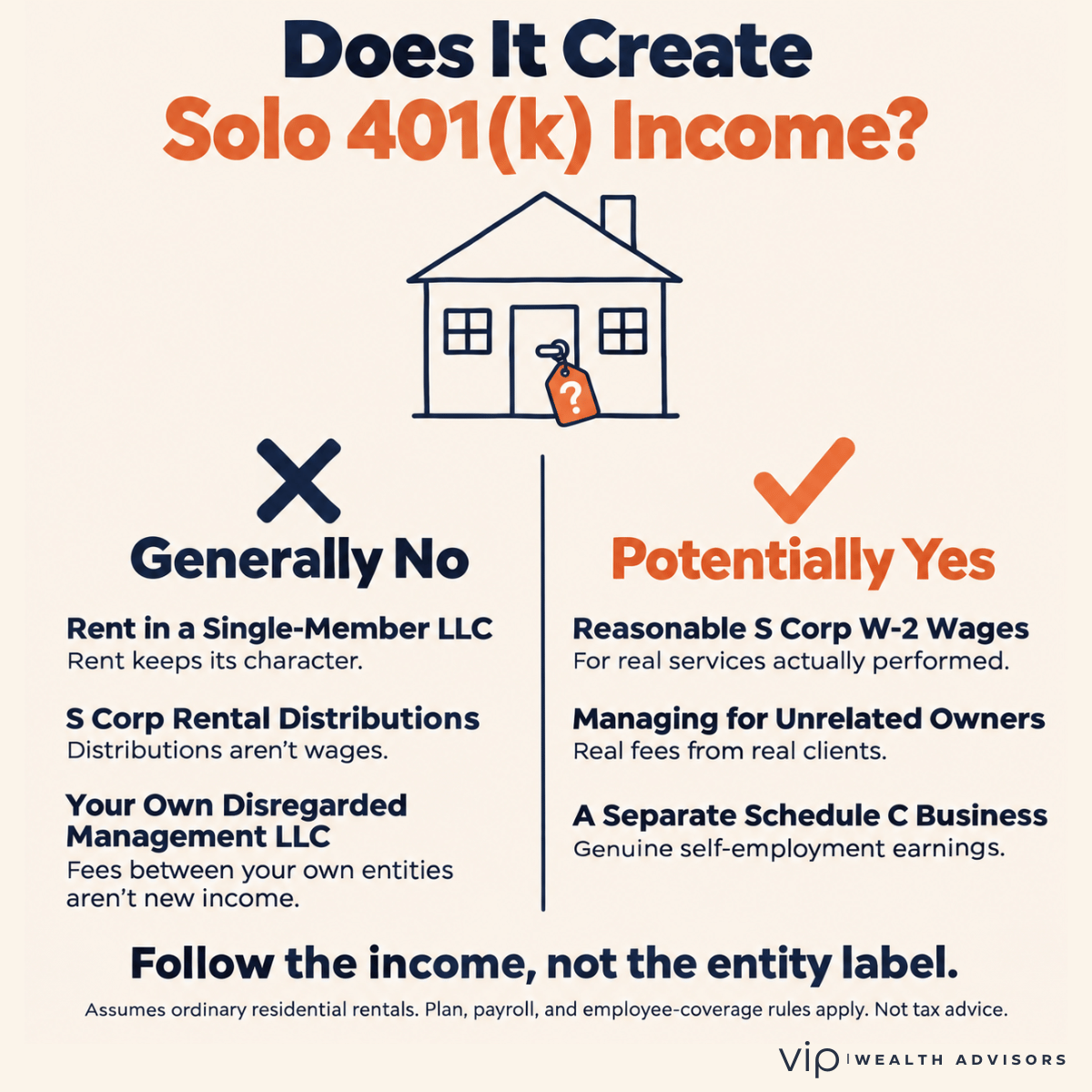
Which Structures Can Support a Solo 401(k)
Moving rental income through an LLC, an S corporation, or your own management company generally doesn’t turn it into retirement-plan compensation. Real wages and real fees for real services can.
Example: Seven Rentals Generating $200,000 of Annual Profit
Assume an individual owns seven conventional residential rentals through single-member LLCs.
The owner is a qualified real estate professional, materially participates, and reports $200,000 of net rental income on Schedule E.
There are no other business earnings or qualifying wages.
| Item | Amount |
|---|---|
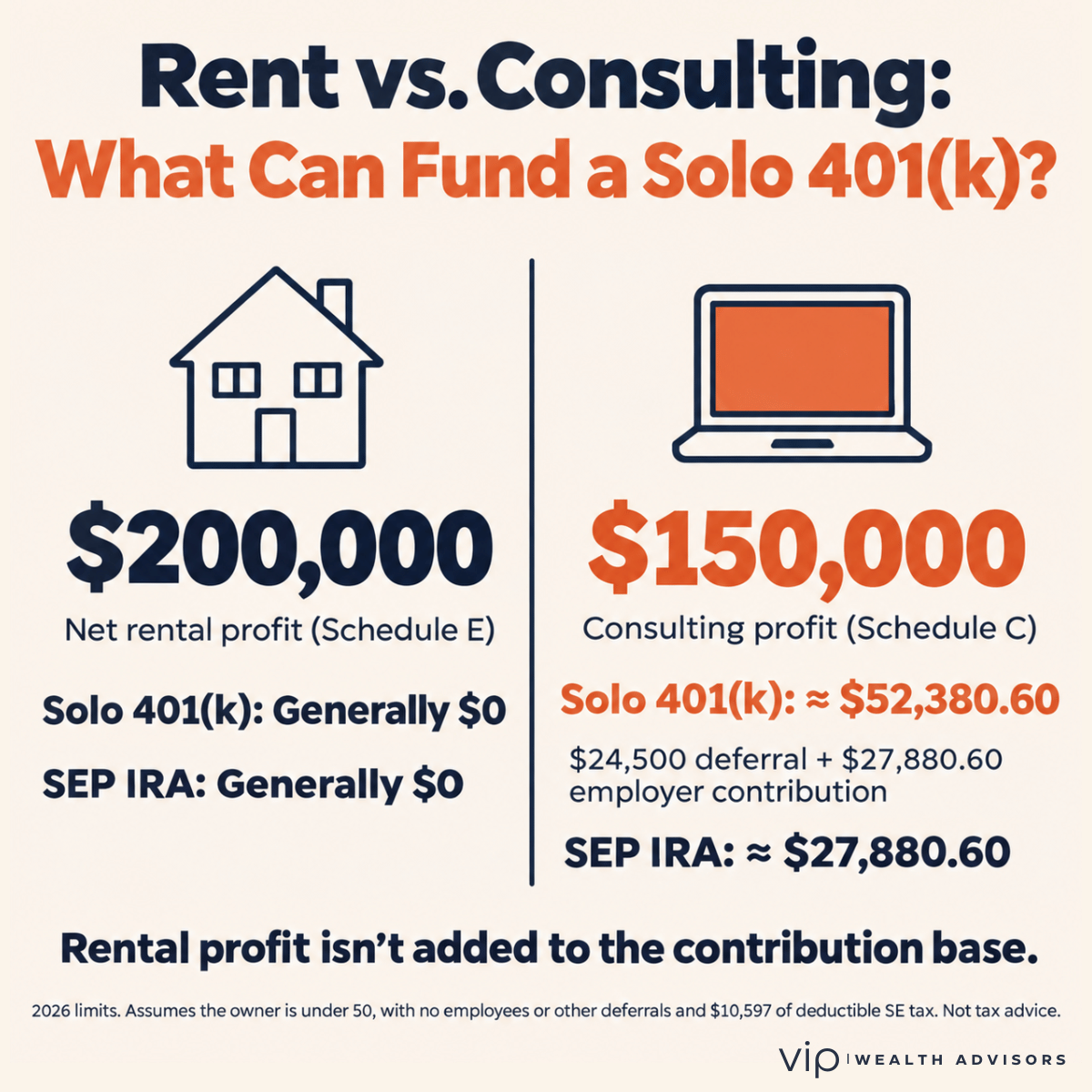
| Net ordinary rental profit | $200,000 |
| Rental income available as qualifying self-employed plan compensation | Generally $0 |
| Solo 401(k) contribution supported solely by this rental profit | Generally $0 |
| SEP IRA contribution supported solely by this rental profit | Generally $0 |
This outcome does not imply the rentals are a hobby, that the owner is not working, or that the property portfolio lacks legitimate business substance.
It is the product of distinct federal tax definitions.
What Changes if the Investor Also Has a Separate Schedule C Business?
A significant amount can change.
Suppose the same investor earns $150,000 of net profit from a separate, legitimate consulting business.
Assume the deductible portion of self-employment tax is $10,597, the owner is under age 50, has no eligible non-owner employees, and has made no elective deferrals elsewhere in 2026.
The eligible contribution base before the employer plan deduction would be $139,403.
In 2026, the regular elective deferral limit is $24,500.
A maximum-rate sole proprietor employer contribution is generally 20% of adjusted net self-employment earnings, or $27,880.60 on these facts.
That yields an estimated Solo 401(k) total of $52,380.60.
A SEP IRA would generally permit approximately $27,880.60, because it has no additional employee elective-deferral component.
The $200,000 of rental income would not be added to either calculation.
These amounts assume the stated half-SE-tax deduction is correct and that no other plan limits or aggregation rules alter the result.
For 2026, the defined contribution annual-additions ceiling is $72,000, separate from eligible catch-up contributions. Age-50 catch-up limits and other rules can change the result for older owners.
Rental Profit vs. Self-Employment Income
In this example, $200,000 of rental profit supports no Solo 401(k) or SEP IRA contribution on its own. A separate $150,000 consulting business could support an estimated $52,380.60 in a Solo 401(k).
Solo 401(k) & SEP IRA Contribution Calculator
VIP Wealth Advisors | 2026 planning estimates for owner-operated businesses
| Qualifying compensation before employer plan deduction | |
| Deductible half of SE tax | |
| Employee regular deferral | |
| Catch-up contribution | |
| Employer profit-sharing | |
| Estimated current-year pre-tax Solo 401(k) deduction | |
| Illustrative federal income-tax reduction (before QBI effects) |
Readers can test their own Schedule C earnings, other deferrals, age, employer contribution rate, and estimated tax benefits using the calculator.
Ordinary rental profit should be entered separately because it is not automatically eligible compensation.
Other Legitimate Strategies for Rental Property Investors
If an investor's only income is ordinary rent, a Solo 401(k) or SEP IRA may not be the right immediate tool. That does not mean retirement or tax planning stops.
Maintain a Separate Business That Earns Real Compensation
Consulting, brokerage, construction, development, third-party management, and other qualifying service activities may generate earned income that supports a retirement plan.
The activity must be genuine, and the appropriate employee and entity rules must be respected.
Use an Employer Retirement Plan if Eligible
Owners who also work for another employer may have access to a 401(k) through that employer.
Employee elective-deferral limits generally apply across relevant plans, even if unrelated employers may have separate employer-contribution limits.
Evaluate an IRA, HSA, and Taxable Investment Portfolio
Traditional or Roth IRA eligibility depends on compensation and applicable income rules, including spousal IRA provisions where available.
An HSA can offer attractive tax treatment if the investor is eligible.
A diversified taxable account can provide liquidity not available in a retirement plan.
Optimize the Real Estate Tax Strategy Itself
Cost segregation, depreciation, qualified business income analysis, passive-activity rules, the timing of property dispositions, and basis planning may matter more economically than forcing a retirement-plan deduction.
These strategies have their own eligibility requirements and risks, particularly depreciation recapture and interest or disposition costs.
Consider Defined Benefit or Cash Balance Planning When There Is Substantial Separate Earned Income
A cash balance plan may permit additional retirement funding but requires an actuarial design, predictable funding capacity, and analysis of the combined deduction rules where a defined contribution plan also exists.
It does not turn Schedule E rental profit into compensation.
One More Trap: Common-Control and Employee Rules
Multiple entities do not always mean multiple separate employers for retirement-plan purposes. Under IRC Sections 414(b), 414(c), and 414(m), commonly controlled trades or businesses and certain affiliated service groups may need to be considered together for qualified-plan rules.
A rental activity can be a trade or business for common-control purposes even when its ordinary rent is excluded from self-employment earnings.
Employees who work at rental properties, in a management company, or in a related business can affect whether the owner's plan qualifies as a one-participant arrangement and who must be offered participation.
Long-term, part-time employee eligibility rules add further complexity. Before adopting a Solo 401(k), review ownership, actual employee duties, related companies, existing retirement plans, and the applicable plan document. Seven distinct LLCs do not make each LLC an independent retirement-plan universe.
Related businesses may have to be analyzed together for retirement-plan coverage. A structure that looks separate on an organizational chart may still be aggregated under qualified-plan rules.
Retirement Planning Should Follow the Income, Not the Entity Label
Successful real estate investors often spend more time operating their properties than traditional wage earners spend at a desk.
That effort matters economically, but federal tax law does not measure retirement-plan contribution eligibility by hours worked or the number of properties owned.
The better approach is to identify which activities truly generate earned income, preserve the economic rationale for each entity, and select retirement and tax strategies that fit the facts.
For some investors, that will mean establishing a Solo 401(k) through a separate operating business. For others, it will mean focusing on real estate taxation, portfolio diversification, liquidity, and long-term estate planning instead.
At VIP Wealth Advisors, the starting point is not how to make a retirement plan fit a structure that does not support one. Instead, it's about coordinating investment real estate, business earnings, taxes, and retirement goals into one coherent financial plan.
Frequently Asked Questions
Can a real estate professional contribute rental profits to a Solo 401(k)?
Generally not if the profits are ordinary rental income excluded from net earnings from self-employment. Real estate professional status under Section 469 does not, by itself, create retirement-plan compensation.
Can I open a SEP IRA if I manage my own rental properties full-time?
You can open an account, but you need qualifying compensation or earned income to make deductible contributions. Ordinary rental profits alone generally will not support SEP IRA contributions.
Does a single-member LLC make my rental income self-employment income?
No. A default disregarded single-member LLC generally does not change the federal income-tax character of ordinary rents.
Can my S corporation sponsor a Solo 401(k) if it owns rental properties?
Potentially, if the S corporation pays legitimate, reasonable W-2 wages for actual services and otherwise satisfies retirement-plan rules. Rental pass-through distributions themselves are not qualifying wages. Entity and payroll planning require careful analysis.
Can I create a property management LLC and charge my own rentals fees?
A management LLC disregarded for federal tax purposes and owned by the same person as the disregarded rental LLCs generally cannot manufacture separate taxable management-fee income through internal transfers. A genuinely separate taxable management business can present a different analysis.
What if I manage rental properties for unrelated owners?
Actual fee income from third-party property management can generate net earnings from self-employment and potentially support a retirement plan, subject to the relevant business, employee, and plan requirements.
Can I contribute to a Solo 401(k) from a separate Schedule C business?
Yes, assuming it generates qualifying net earnings, the plan's conditions are met, and applicable limits are respected. Ordinary rental earnings from the investor's separate rental portfolio are not added to the contribution base.
Are Airbnb or short-term rental profits treated differently?
Sometimes. The key distinction is the level and nature of services provided to guests, not merely the length of the rental or the platform used. Substantial services primarily for occupants' convenience can result in different self-employment tax treatment. Analyze the actual services and facts.
Do separate LLCs avoid the employee rules for a Solo 401(k)?
Not necessarily. Related businesses can be aggregated under common-control or affiliated-service-group rules. Eligible workers in a related entity may affect the owner's plan.
Own Rental Property and Wondering Which Retirement Strategies Actually Fit?
Rental income, operating businesses, entity structure, employee rules, and retirement-plan limits can interact in ways that are easy to oversimplify. VIP Wealth Advisors coordinates these moving pieces as part of a broader financial and tax planning strategy.