

Section 351 ETF exchanges can still defer capital gains for qualifying diversified portfolios, but new IRS guidance targets prearranged ETF transactions that rapidly swap appreciated securities for a materially different portfolio without recognizing gain.
Key Takeaways
- Section 351 usually requires an already-diversified portfolio. One highly concentrated stock position generally does not qualify.
- The IRS is targeting prearranged ETF swaps. The concern is using an ETF to quickly transform one appreciated portfolio into a materially different one without recognizing gain.
- Section 351 is still viable in the right circumstances. The focus should be on diversification, tax planning, and genuine investment purpose.
- The $30 Million Post-IPO Concentrated Stock Problem
- What Is a Section 351 Exchange?
- Why a $30 Million Single-Stock Position Creates a Problem
- What If the Investor Owns Other Securities?
- So What Did Wall Street Figure Out?
- The Transaction the IRS Just Targeted
- The IRS Says the ETF Can Be Treated as a Conduit
- Section 351 ETF Exchanges Are Not Dead
- Is There a Required Holding Period?
- What Should the $30 Million Post-IPO Executive Do Instead?
- Concentrated Stock Planning Is About More Than Capital Gains Taxes
- The Bigger Message From Treasury
- The Bottom Line for Post-IPO Investors
- Frequently Asked Questions
Your company just went public. After years of building the business, accumulating equity compensation, or exercising stock options, your shares are now worth $30 million. Your cost basis may be only a fraction of that amount. On paper, you are extraordinarily wealthy. But you also have a problem: a significant portion of your wealth may be tied to a single stock. You would like to diversify. However, selling the shares could generate tens of millions of dollars in taxable capital gains.
Then someone tells you about a Section 351 ETF exchange, a strategy that may allow investors to contribute appreciated securities to an exchange-traded fund (ETF) without immediately recognizing capital gains. It sounds almost perfect. There is just one problem. If your $30 million portfolio consists primarily of one company’s stock, you generally cannot simply contribute that position to a diversified ETF and make the capital gain disappear.
Recent guidance from the IRS and U.S. Treasury has increased scrutiny of sophisticated ETF transactions designed to transform appreciated portfolios without recognizing the gains that would ordinarily accompany that transformation.
On September 28th, 2026, the IRS issued Revenue Ruling 2026-20 and Notice 2026-62, targeting certain transactions involving Section 351 contributions and ETF in-kind redemptions. The IRS concluded that under the facts described in the ruling, transactions that appear separately to qualify for tax-free treatment can be combined and treated as a taxable exchange when they are part of a prearranged plan to produce a materially different portfolio.
For executives, founders, and early employees approaching or emerging from an IPO or other liquidity event, it's important to understand what changed, and what didn't.
The $30 Million Post-IPO Concentrated Stock Problem
Consider an executive whose company recently completed an IPO.
Company Stock Value: $30 million
Tax Basis: $2 million
Unrealized Capital Gain: $28 million
Her career may have produced tremendous wealth, but much of that wealth is concentrated in one company. From an investment-planning standpoint, diversification may be desirable. But diversification has a tax cost. If she sells the entire $30 million position, she could recognize about $28 million in capital gains.
Depending on her circumstances, that gain could potentially be subject to the 20% federal long-term capital gains rate, the 3.8% Net Investment Income Tax, and applicable state income taxes. This creates a tension we see frequently when planning around concentrated equity: The investment portfolio says diversify. The tax return says wait.
The investment portfolio says diversify. The tax return says wait.
That tension has helped drive interest in increasingly sophisticated strategies designed to diversify appreciated securities while deferring capital gains. One such strategy involves Section 351 of the Internal Revenue Code.
What Is a Section 351 Exchange?
Section 351 generally provides that no gain or loss is recognized when property is transferred to a corporation solely in exchange for stock of that corporation if the applicable control requirements are satisfied.
Because an ETF is generally organized as a corporation or trust treated as a corporation for federal tax purposes, Section 351 can potentially be used when investors contribute securities to a newly created ETF in exchange for ETF shares.
Traditional path: Selling appreciated securities → recognizing capital gain → purchasing a diversified portfolio
Potential Section 351 path: Contribute appreciated securities → receive ETF shares → defer recognition of the embedded capital gain
But an enormously important distinction remains. Tax deferral is not tax elimination.
In a qualifying Section 351 transaction, the investor generally receives carryover basis in the ETF shares. The embedded gain has not magically disappeared. Instead, the tax liability effectively carries forward into the new investment. However, for an investor with substantial embedded gains, controlling when those gains are recognized can still be extremely valuable.
Why a $30 Million Single-Stock Position Creates a Problem
This is where the Section 351 strategy becomes particularly relevant to executives and founders.
Section 351 contains special rules for transfers to investment companies. Section 351(e) generally prevents taxpayers from using the provision to obtain tax-free diversification by transferring concentrated investments to an investment company.
Treasury regulations provide an important exception for a portfolio that is already sufficiently diversified before the contribution.
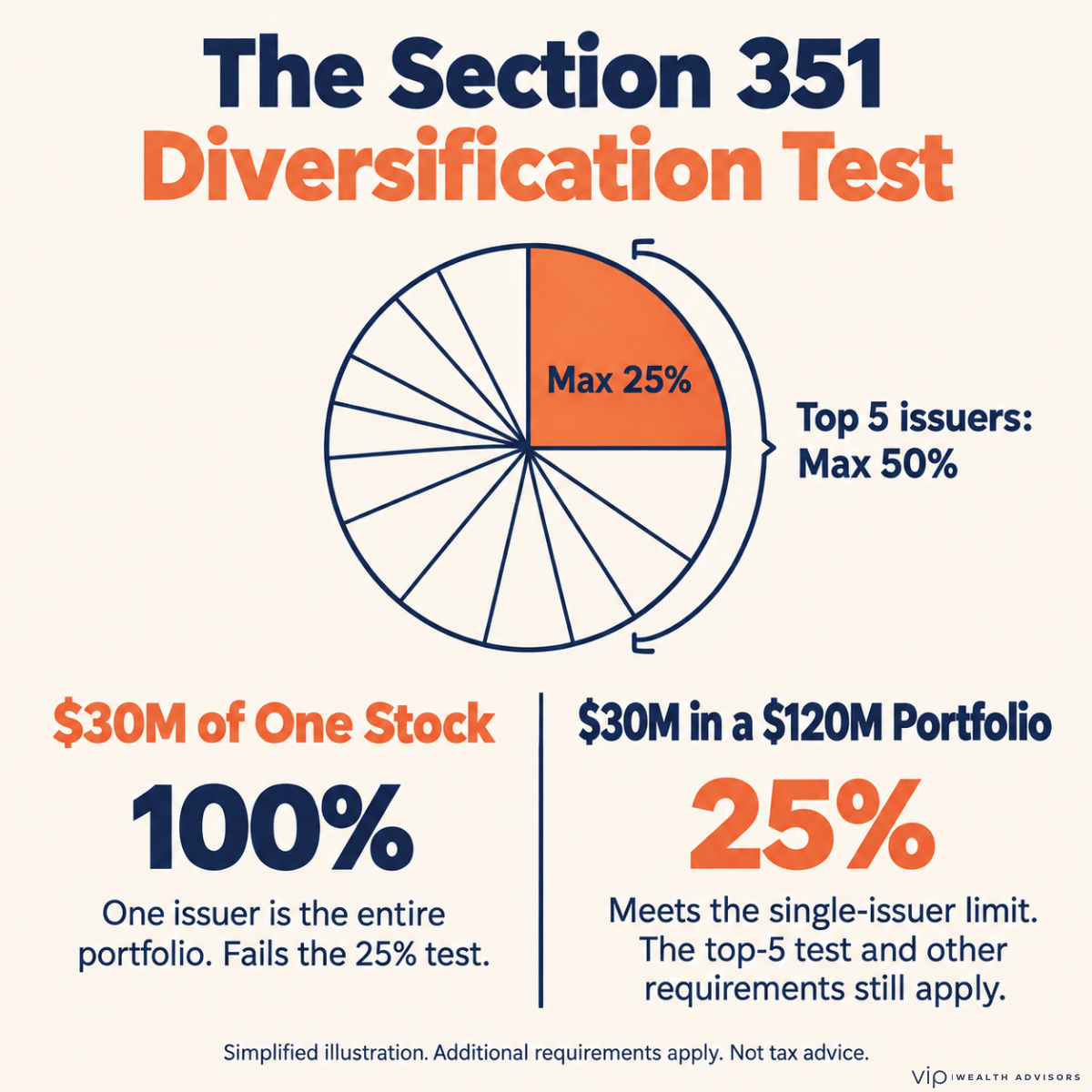
Generally, a portfolio can satisfy the applicable diversification test when no single issuer represents more than 25% of the value of the portfolio, and the five largest issuers collectively represent no more than 50% of the portfolio.
Consequently, an investor holding $30 million of one company's stock does not simply satisfy the diversification requirement by contributing those shares to an ETF. The stock represents 100% of the contributed portfolio, far above the 25% single-issuer threshold. This is a crucial point for post-IPO executives.
Section 351 can be extraordinarily useful in the right circumstances, but it generally isn't a mechanism to take one enormous appreciated stock position, put it in an ETF, and instantly emerge with a diversified portfolio without recognizing gain.
What If the Investor Owns Other Securities?
Now suppose our executive is considerably wealthier and owns other marketable securities in addition to the $30 million concentrated stock position. Conceptually, if the entire $30 million Company X position were included in a qualifying diversified portfolio, Company X could represent no more than 25% of the contributed portfolio. That means the overall portfolio would need to be at least approximately:
| Portfolio Component | Approximate Value |
|---|---|
| Company X stock | $30 million |
| Other qualifying securities | $90 million |
| Total portfolio | $120 million |
Company X would then represent 25% of the portfolio. Even that does not automatically solve the problem because the portfolio would also need to satisfy the top-five issuer limitation and other transaction-specific requirements. But this illustrates something important.
Section 351 may be far more applicable to an investor who already owns a large, diversified taxable portfolio containing appreciated positions than to the founder whose $30 million net worth consists predominantly of one company.
The Section 351 Diversification Test at a Glance
A single-stock position fails the 25% single-issuer limit on its own. Even inside a much larger portfolio, it must also clear the top-five issuer test and other requirements.
So What Did Wall Street Figure Out?
This is where the strategy became more aggressive. ETFs possess another significant tax advantage. Section 852(b)(6) generally permits a regulated investment company to distribute appreciated securities in certain in-kind redemptions without recognizing gain at the fund level. This mechanism is fundamental to the tax efficiency of ETFs. Large financial institutions known as authorized participants, or APs, regularly create and redeem ETF shares by exchanging baskets of securities with the ETF.
These ordinary ETF creation and redemption transactions occur throughout the marketplace and are not themselves what Treasury is attacking. Notice 2026-62 specifically acknowledges the conventional ETF creation-and-redemption mechanism. The problem arises when Section 351 and the ETF redemption mechanism are deliberately combined to produce something very different.
The Transaction the IRS Just Targeted
Revenue Ruling 2026-20 describes an investor contributing an appreciated, already-diversified portfolio to a newly established ETF in a transaction intended to qualify under Section 351. That distinction matters. The ruling does not involve our executive simply dropping $30 million of one stock into an ETF. The investor in the ruling has already crossed the diversification hurdle. The transaction then proceeds further.
As part of the same overall plan, the ETF issues shares to an authorized participant in exchange for securities the ETF actually wants to own, or cash that can be used to acquire those securities. Shortly thereafter, the ETF redeems the authorized participant's shares by distributing some or all of the appreciated securities the investor originally contributed.
The result? The investor started with one portfolio. The investor ends up owning shares of an ETF containing a materially different portfolio. Yet the structure was designed so that the investor would not recognize the built-in gains associated with that portfolio transformation. That is where the IRS drew the line.
The IRS Says the ETF Can Be Treated as a Conduit
Revenue Ruling 2026-20 applies longstanding substance-over-form and step-transaction principles. Instead of viewing the transaction as two completely independent events:
1. A tax-deferred Section 351 contribution, followed by
2. A separate tax-free ETF in-kind redemption,
the IRS looks at the entire arrangement.
When the transactions are components of the same plan, the IRS concluded that the ETF's temporary ownership of the securities can be disregarded.
Economically, the ETF served as a conduit through which the investor's appreciated securities moved to the authorized participant while the investor ended up with exposure to a materially different investment portfolio.
Under the ruling, the investor can instead be treated as engaging in a taxable exchange under Section 1001 with the authorized participant. That is a dramatically different tax result.
Section 351 ETF Exchanges Are Not Dead
This point is extremely important. The IRS did not say that all Section 351 ETF conversions are abusive or taxable. In fact, Notice 2026-62 specifically states that it does not address transactions in which Section 351 is used to seed a newly established ETF with assets that are consistent with the ETF's investment thesis and are intended and expected to remain in the ETF absent a substantial change in circumstances.
That creates an important distinction. Imagine an investor owns an already-diversified portfolio of appreciated U.S. equities that closely resembles the investment strategy of a new ETF. Those securities are contributed to the ETF, and the ETF genuinely intends to own them as part of its ongoing investment strategy.
Section 351 ETF exchanges are not dead. The key question is whether the transaction has genuine investment substance.
That is very different from contributing a portfolio that the ETF never really intends to keep and implementing a prearranged series of transactions to move those securities out while replacing them with an entirely different portfolio.
The first can represent legitimate ETF seeding. The second begins to resemble a mechanism that indirectly accomplishes what the investor could not do directly without recognizing gain.
What Revenue Ruling 2026-20 Targets
The IRS focused on prearranged plans that use an ETF as a pass-through to swap an appreciated portfolio for a different one. Seeding an ETF with assets it intends to keep was not the target.

Is There a Required Holding Period?
Not yet. This is one of the most interesting unresolved questions arising from the new guidance. Revenue Ruling 2026-20 refers to securities being distributed “shortly thereafter.” But Treasury has not established a bright-line rule defining exactly what that means. There is currently no simple rule stating that contributed securities must remain in the ETF for 30 days, six months, one year, or some other predetermined period.
Instead, the analysis will likely depend heavily on the facts and circumstances, including whether there was a prearranged plan, the ETF's investment thesis, the expected disposition of the contributed securities, the timing of subsequent transactions, and whether the ETF ultimately holds a materially different portfolio.
Notice 2026-62 requests public comments by October 28, 2026, and Treasury and the IRS are considering additional guidance. For taxpayers and advisors, that uncertainty matters.
What Should the $30 Million Post-IPO Executive Do Instead?
This brings us back to our executive holding $30 million of Company X stock with a tax basis of just $2 million. Rather than focusing narrowly on whether those shares can be transferred into a Section 351 ETF, the planning priority should be developing a comprehensive strategy to transition this highly appreciated, concentrated position into a more diversified portfolio while carefully managing the timing and magnitude of the resulting capital gains tax liability.
The answer may involve several strategies working together. A portion of the stock might be sold over multiple tax years. Shares might be donated directly to charity or contributed to a donor-advised fund if the client already plans to give. A charitable remainder trust may be worth evaluating in appropriate circumstances.
An exchange fund may provide another avenue for certain qualified investors willing to accept its liquidity requirements and typically lengthy holding period. Other portions of the position might remain concentrated temporarily while the investor builds diversification elsewhere. Tax-loss harvesting and direct indexing can potentially generate losses that offset some future realized gains. Depending upon the client's objectives, estate-planning strategies may also influence which shares should ultimately be sold, gifted, donated, transferred, or retained.
For certain executives, hedging or borrowing strategies may also deserve consideration, although those approaches introduce their own investment, tax, financing, and risk-management considerations. The objective should not necessarily be to avoid realizing any capital gain. The objective should be to determine which gains to realize, when to realize them, and what the investor receives economically in exchange for paying the tax.
The objective should not necessarily be to avoid realizing any capital gain. It should be to decide which gains to realize, when, and why.
Concentrated Stock Planning Is About More Than Capital Gains Taxes
A $30 million concentrated position presents an unusual planning problem because taxes are only one side of the equation. Refusing to sell solely because of taxes can leave an investor exposed to enormous company-specific risk. Conversely, liquidating an entire low-basis position immediately without considering taxes, charitable goals, estate planning, future liquidity needs, state residency, and other planning opportunities can create an unnecessarily large tax bill.
Neither extreme automatically represents good planning. This matters especially for executives approaching an IPO. Ideally, concentrated-stock planning begins before the liquidity event, when opportunities may still exist for option exercises, charitable transfers, estate-planning strategies, residency planning, 10b5-1 plans, and other decisions that become harder after the stock becomes publicly traded or after appreciation has already occurred.
The eventual diversification strategy should therefore be coordinated across investment management, income-tax planning, equity compensation, estate planning, and cash-flow needs.
The Bigger Message From Treasury
Revenue Ruling 2026-20 should also be understood as part of a broader Treasury initiative. Notice 2026-62 identifies several investment-fund strategies Treasury and the IRS are examining, including certain partnership variations, box-spread ETF strategies, dividend record-date strategies, and various “tax-aware” trading strategies designed to affect the timing or character of gains and losses. Treasury has indicated that additional guidance could follow, potentially including regulations, notices, additional revenue rulings, or identification of certain arrangements as transactions of interest or listed transactions.
For high-net-worth investors, the lesson is not that sophisticated tax planning has suddenly become inappropriate. It is that economic substance matters. A strategy should have a sound investment and planning rationale independent of merely stringing together multiple tax provisions to produce an outcome that those provisions were not intended to create.
The Bottom Line for Post-IPO Investors
Section 351 remains an important tax code provision, and properly structured ETF contributions may continue to offer meaningful tax-deferral opportunities for investors with sufficiently diversified appreciated portfolios.
But it is not a magic wand for someone holding $30 million of a single low-basis stock. Revenue Ruling 2026-20 makes clear that even investors who meet the initial diversification requirements should be cautious about arrangements that use an ETF as an intermediary to rapidly transform one appreciated portfolio into a materially different one without recognizing gain.
For founders, executives, and early employees approaching an IPO or liquidity event, that makes advance planning increasingly important. The goal should not simply be to find a transaction that appears to avoid capital gains taxes. The better objective is to create a coordinated strategy that answers a much more useful question: How do we convert concentrated wealth into durable, diversified wealth while managing taxes intelligently along the way?
That is ultimately a portfolio-management, tax-planning, and wealth-planning decision, and you should consider all three together.
Frequently Asked Questions About Section 351 ETF Exchanges and Concentrated Stock
Can I put $30 million of one stock into an ETF tax-free under Section 351?
Generally, no, not simply to create diversification. Section 351 contains special rules involving transfers to investment companies, and a portfolio of securities generally must already satisfy applicable diversification requirements. A portfolio consisting entirely of one company's stock would not satisfy the commonly referenced 25/50 diversification test.
What is the 25/50 diversification rule?
Generally, for purposes of the relevant Section 351 investment-company rules, no single issuer may represent more than 25% of the portfolio's value, and the five largest issuers collectively may not represent more than 50%. Additional rules and facts can affect the analysis, so meeting these percentages alone does not guarantee Section 351 treatment.
Does a Section 351 exchange eliminate capital gains taxes?
No. A qualifying Section 351 transaction generally defers recognition rather than eliminating the embedded gain. The investor generally takes a carryover basis in the stock received, preserving the built-in gain for potential recognition later.
What did Revenue Ruling 2026-20 change?
The ruling addresses a planned transaction in which an investor contributes an appreciated diversified portfolio to a new ETF, after which the ETF uses an in-kind redemption to transfer those contributed securities to an authorized participant and ends up with a materially different portfolio. The IRS concluded that the planned steps can be integrated under substance-over-form and step-transaction principles and treated as a taxable exchange under Section 1001.
Are Section 351 ETF exchanges now illegal?
No. The new guidance does not prohibit Section 351 ETF transactions generally. Notice 2026-62 expressly says it does not address certain transactions involving the seeding of a new ETF with assets consistent with the ETF's investment thesis that are intended and expected to remain in the ETF absent substantially changed circumstances.
How long must securities remain in an ETF after a Section 351 contribution?
The new guidance does not establish a specific minimum holding period. The IRS's use of “shortly thereafter” makes timing relevant, but the analysis also depends upon the overall facts, including whether subsequent transactions were part of the original plan.
What is the difference between a Section 351 ETF exchange and an exchange fund?
They are fundamentally different structures. A Section 351 ETF transaction generally involves contributing a sufficiently diversified portfolio of securities to an ETF in exchange for ETF shares while seeking nonrecognition under Section 351.
An exchange fund is generally a private partnership in which multiple investors contribute concentrated positions and receive an interest in the pooled portfolio. Exchange funds have their own qualification requirements, costs, investment considerations, and liquidity restrictions, including a commonly discussed seven-year period associated with certain tax treatment upon redemption.
Can an exchange fund work for someone with one highly concentrated stock?
Potentially. This is one reason executives and founders with large concentrated positions often consider exchange funds. However, you need to evaluate eligibility, portfolio construction, liquidity (7-year lock-up), fees, diversification benefits, tax consequences, and the investor's overall financial plan.
What other strategies can help diversify low-basis concentrated stock?
Depending upon the investor's circumstances, planning could include staged sales, charitable gifting, donor-advised funds, charitable remainder trusts, exchange funds, direct indexing and tax-loss harvesting, estate-planning strategies, hedging, borrowing, or combinations of several approaches. There is no single strategy that is appropriate for every concentrated-stock holder.
When should executives begin planning around concentrated stock?
Ideally, planning begins well before an IPO, tender offer, acquisition, or other liquidity event. Decisions involving option exercises, charitable gifts, estate planning, state residency, trading restrictions, 10b5-1 plans, and eventual diversification can have dramatically different consequences depending upon when they are implemented. For executives with substantial equity compensation, they should develop their tax and investment strategies together rather than after the liquidity event has already occurred.
Planning Around a Large Concentrated Stock Position?
If a major portion of your wealth is tied to one stock, the right question is rarely “How do I avoid all capital gains?” The better question is how to diversify deliberately while coordinating taxes, liquidity, charitable planning, estate strategy, and portfolio risk.
VIP Wealth Advisors helps founders, executives, and equity-compensated professionals build a coordinated plan before a sale, IPO, tender offer, or other liquidity event forces the decision.