

Before selling a highly appreciated business, investment property, or private-company position, evaluate whether capital gains can first be eliminated, then deferred or reduced, because many of the strongest tax-planning opportunities disappear once the sale becomes binding.
Key Takeaways
- Look for ways to eliminate the gain first. QSBS or charitable planning may be more valuable than tax deferral.
- Match the strategy to the asset. A 1031 exchange, installment sale, or other structure may apply depending on what you’re selling.
- Deferred Sales Trusts require careful structuring. Timing, independence, and economic substance matter.
- Always compare the strategy with simply paying the tax. The goal is greater after-tax wealth—not tax deferral for its own sake.
- Why Capital Gains Planning Needs to Happen Before You Sell
- Start With the Best Outcome: Can Any of the Gain Be Eliminated?
- Defer Real Estate Gains With a 1031 Exchange
- Can a Deferred Sales Trust Really Defer Capital Gains for Decades?
- The DST Trap: Timing and Independence Matter
- What Deferred Sales Trust Marketing May Leave Out
- Be Careful Trying to “Have Your Cake and Eat It Too”
- How Should You Decide Which Capital Gains Strategy Is Best?
- The Best Time to Plan for a Liquidity Event Is Before You Have One
- Frequently Asked Questions
Selling a valuable asset should be a good problem to have. Maybe you spent 20 years building a business that is now worth $10 million. Maybe the investment property you bought for $1 million is worth $6 million. Or perhaps you joined a private company early and now hold stock worth several million dollars. Eventually, all three situations lead to the same question:
How do you turn a highly appreciated asset into diversified, spendable wealth without unnecessarily giving a large portion of the gain away to taxes?
The answer may involve much more than simply calculating the capital gains tax.
Depending on what you own, how you own it, and what you want to accomplish after the sale, there may be opportunities to reduce the tax, defer it for years, or potentially eliminate some of the gain altogether.
Many of the most powerful strategies need to be implemented before the sale becomes a done deal. Waiting until after the transaction has been negotiated can eliminate options that may have been available earlier.
Why Capital Gains Planning Needs to Happen Before You Sell
Consider a simplified example. You own an asset worth $10 million with an adjusted tax basis of $2 million. Selling it creates an $8 million gain. Depending on the asset and your circumstances, that gain could be subject to federal long-term capital gains tax, the 3.8% Net Investment Income Tax, state income taxes, depreciation recapture, and possibly ordinary income treatment for portions of the transaction.
The resulting tax liability could easily reach seven figures. But here's where good planning becomes important. The question shouldn't simply be: “How can I defer my capital gains tax?”
- Can any of the gain be eliminated?
- Can some of the remaining gain be deferred?
- Can the transaction be structured more tax-efficiently?
- How does every strategy compare with simply paying the tax and investing the remaining proceeds?
That framework can lead to very different answers depending on what you're selling.
Start With the Best Outcome: Can Any of the Gain Be Eliminated?
Before trying to defer a tax, determine whether you actually need to pay it.
Qualified Small Business Stock
For founders, executives, and early employees selling private-company stock, one of the first things to investigate is whether the shares qualify for the Qualified Small Business Stock exclusion under Section 1202. When all requirements are satisfied, QSBS may allow an eligible shareholder to exclude millions of dollars in otherwise taxable capital gains.
Never build an elaborate strategy to defer a tax you may not have to pay in the first place. QSBS rules are complicated, but eligibility should be evaluated well before a contemplated liquidity event.
Charitable Planning Before a Sale
Charitably inclined investors may have another opportunity. Instead of selling an appreciated asset and then donating the proceeds, it may be possible to donate the asset itself to a charity, donor-advised fund, or certain charitable trusts before the sale.
Depending on the structure and circumstances, it can potentially avoid capital gains tax on the donated portion while also generating a charitable deduction. A Charitable Remainder Trust (CRT), for example, can sometimes play a role when someone wants to combine philanthropy with an income stream and diversification of a concentrated asset.
But timing again matters. Once a sale is effectively predetermined, transferring an asset immediately before closing doesn't necessarily eliminate the tax consequences. The assignment-of-income and prearranged-sale doctrines need to be considered.
Strategy #2: Defer Real Estate Gains With a 1031 Exchange
Real estate investors have another powerful tool: the Section 1031 like-kind exchange. A properly structured 1031 exchange allows an investor to sell qualifying investment or business real estate and defer the gain by reinvesting in qualifying replacement real estate.
Investors generally have 45 days to identify replacement property and 180 days to complete the exchange.
And there's a bigger practical issue: What if you don't want to own more real estate?
Imagine you've spent 25 years managing rental properties and are finally ready to simplify your life. Buying another apartment building solely to avoid taxes may not align with your financial plan. That's one reason some investors begin looking at another strategy: a Deferred Sales Trust.
Can a Deferred Sales Trust Really Defer Capital Gains for Decades?
A Deferred Sales Trust, commonly abbreviated as a DST, is designed around the installment-sale rules of Internal Revenue Code Section 453.
How the Basic Structure Works
- You sell the appreciated asset to an independently administered trust.
- The trust gives you a promissory note in exchange for the asset.
- The trust sells the asset to an outside buyer and receives the sale proceeds.
- The proceeds can then be invested within the trust, subject to the governing documents and investment strategy.
- The trust makes payments to you under the promissory note.
If the transaction qualifies for installment-sale treatment, you generally recognize the corresponding gain as principal payments are received rather than recognizing the entire gain when the outside buyer purchases the asset.
A Simplified $10 Million Example
Return to our hypothetical $10 million asset with a $2 million basis. Ignoring additional complications, the gross-profit percentage would be 80%. If the trust subsequently paid you $500,000 of principal, approximately $400,000 would be taxable gain and $100,000 would be a recovery of basis. Interest paid on the note would generally be taxed separately as interest income.
Stretch those payments over many years and a significant portion of the original capital gain could potentially remain deferred during that period. That's where claims about deferring capital gains for decades come from.
A Deferred Sales Trust isn't a special capital gains tax break created by Congress.
There isn't a section of the Internal Revenue Code that says, “Follow these Deferred Sales Trust rules and your transaction is approved.” Instead, a DST is a particular transaction structure designed to qualify under the existing Section 453 installment-sale rules. That makes the details extraordinarily important.
The DST Trap: Timing and Independence Matter
Suppose you've negotiated the sale of your company to a private equity firm for $10 million. The material terms are finalized. You've signed a binding purchase agreement. Then someone tells you about Deferred Sales Trusts. You create a trust, transfer the company to it, and the trust immediately completes the transaction you had already agreed to.
There's a problem.
The IRS could potentially argue that, economically, you sold the business directly to the private equity firm and merely inserted the trust into an already predetermined transaction. Tax law generally cares about substance as well as form. A defensible DST structure, therefore, requires much more than paperwork.
Among other considerations, the trustee's independence matters. The trust should acquire meaningful ownership of the asset. The trust should not merely be acting as the seller's agent or conduit, and the facts surrounding the ultimate sale must support the legal structure.
Concepts such as the step-transaction doctrine and substance-over-form doctrine become extremely important.
If you're considering a Deferred Sales Trust, the conversation should happen before you sign the purchase agreement, not when your tax return is being prepared the following April. By then, the planning opportunity may already be gone.
What Deferred Sales Trust Marketing May Leave Out
The potential tax deferral sounds fantastic. But there are several important issues investors need to understand before focusing on the headline tax savings.
Depreciation Recapture May Be Taxable Immediately
Installment-sale treatment does not necessarily defer every dollar of tax. For depreciated business and real estate assets, certain depreciation recapture generally must be recognized in the year of the disposition. That can be particularly important for investors who have taken significant depreciation deductions or completed cost-segregation studies.
Publicly Traded Stock Generally Doesn't Qualify
Section 453 generally doesn't permit installment-sale treatment for stock or securities traded on an established securities market. Closely held private-company stock can present a different situation and may potentially qualify depending on the facts.
Again, though, private-company shareholders should investigate other opportunities—particularly QSBS—before assuming an installment sale is the best strategy.
Large Installment Sales Can Carry an Interest Charge
For large installment obligations, Section 453A can impose an interest charge associated with the deferred tax liability. This is especially relevant in the multimillion-dollar transactions where DSTs tend to receive the most attention. Tax deferral therefore isn't necessarily free.
You Don't Have the Sale Proceeds
This may be the most overlooked economic reality. If you sell a $10 million asset to a trust in exchange for a promissory note, you don't personally have $10 million sitting in your brokerage account. You have a promise of payment. The trust owns the assets.
A DST can introduce liquidity, investment, trustee, structural, and credit considerations that don't exist when you simply sell the asset, pay the tax, and control the remaining proceeds yourself.
Don't Confuse the Two Different “DSTs”
There's another source of confusion. A Deferred Sales Trust is completely different from a Delaware Statutory Trust.
| Strategy | What It Is | Primary Tax Concept |
|---|---|---|
| Deferred Sales Trust | An installment-sale transaction structure involving a trust and promissory note. | Section 453 installment-sale treatment |
| Delaware Statutory Trust | A legal entity commonly used as a fractional real estate investment. | May potentially serve as replacement property in a properly structured Section 1031 exchange |
Same acronym. Very different strategies.
Be Careful Trying to “Have Your Cake and Eat It Too”
There's another area where investors should be particularly cautious. Imagine someone tells you: “You can sell your $10 million asset, defer the entire gain for decades, and we'll show you how to immediately access virtually all $10 million anyway.”
A strategy promising long-term tax deferral and unrestricted immediate access to substantially all of the money deserves scrutiny.
The IRS has specifically targeted certain monetized installment sale transactions in which taxpayers attempt to combine installment-sale treatment with financing that effectively gives them immediate access to most of the sale proceeds.
There are also rules that can accelerate installment-sale income when an installment obligation is pledged as security for certain debt. This doesn't mean every Deferred Sales Trust is a monetized installment sale.
It does mean investors should be skeptical of any strategy promising both long-term tax deferral and unrestricted immediate access to substantially all of the money. Economic substance matters.
How Should You Decide Which Capital Gains Strategy Is Best?
This is where planning should move beyond finding the strategy with the biggest advertised tax savings. I prefer a hierarchy.
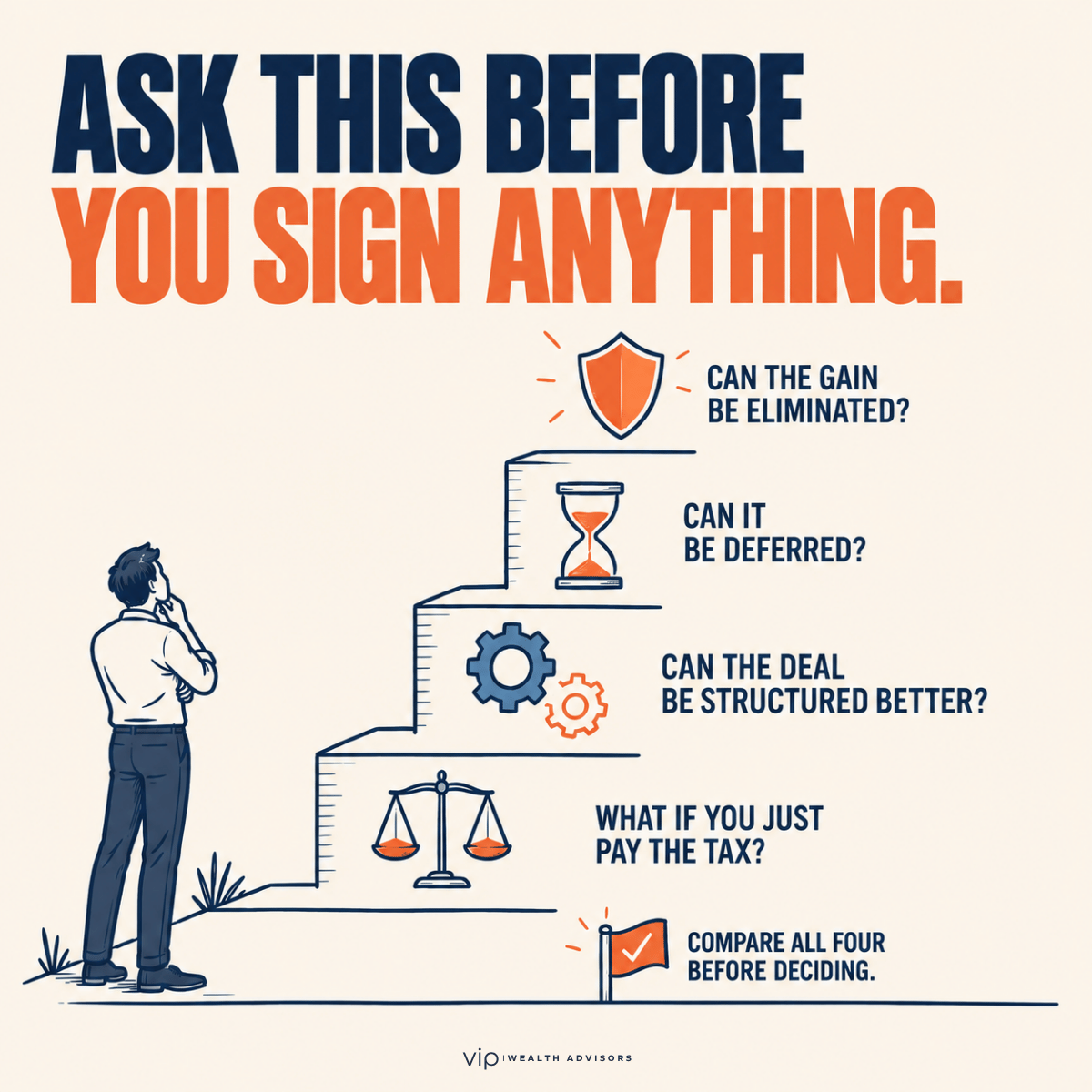
1. Can We Eliminate Any of the Gain?
Start with opportunities such as QSBS, charitable planning, basis considerations, and any other applicable exclusions.
2. Can We Defer the Remaining Gain Through a Straightforward Strategy?
Depending upon the asset, that might include a 1031 exchange or traditional installment sale.
3. Does a More Sophisticated Structure Improve the Outcome?
That's where strategies such as a Deferred Sales Trust or Charitable Remainder Trust might enter the conversation.
4. What Happens If We Simply Pay the Tax?
Never skip this calculation. Compare the sophisticated strategy against selling the asset, paying the tax, and investing the remaining proceeds in a diversified portfolio that you control.
The comparison should account for potential capital gains taxes, note interest, Section 453A interest charges, trust taxation, investment taxation, trustee expenses, legal costs, administrative fees, investment expenses, liquidity restrictions, and eventual taxes as payments are received.
Then evaluate the projected after-tax wealth under both scenarios. Because ultimately, tax deferral isn't the goal. Maximizing your after-tax wealth while preserving the flexibility you need is the goal.
Sometimes the sophisticated strategy wins. Sometimes paying the tax is the better financial decision. The useful comparison is long-term after-tax wealth, liquidity, control, risk, and flexibility—not simply the size of the initial tax bill.
The Best Time to Plan for a Liquidity Event Is Before You Have One
If you're considering selling a business, investment property, or substantial private-company position, some of the most valuable planning may happen months—or even years—before the transaction.
That means evaluating your cost basis, ownership structure, QSBS eligibility, charitable intentions, estate plan, state residency, investment strategy, and potential sale structure while you still have options. Once a transaction becomes binding, some of those options may disappear.
At VIP Wealth Advisors, we help business owners, real estate investors, executives, and families with concentrated wealth coordinate the tax, investment, and financial-planning decisions surrounding major liquidity events.
The objective isn't simply to find a clever way to postpone a tax bill. It's to determine how a major financial event can translate into greater financial independence, diversification, flexibility, and long-term after-tax wealth.
Frequently Asked Questions About Capital Gains Tax Planning Before a Major Sale
What are the main strategies for reducing capital gains tax before selling a highly appreciated asset?
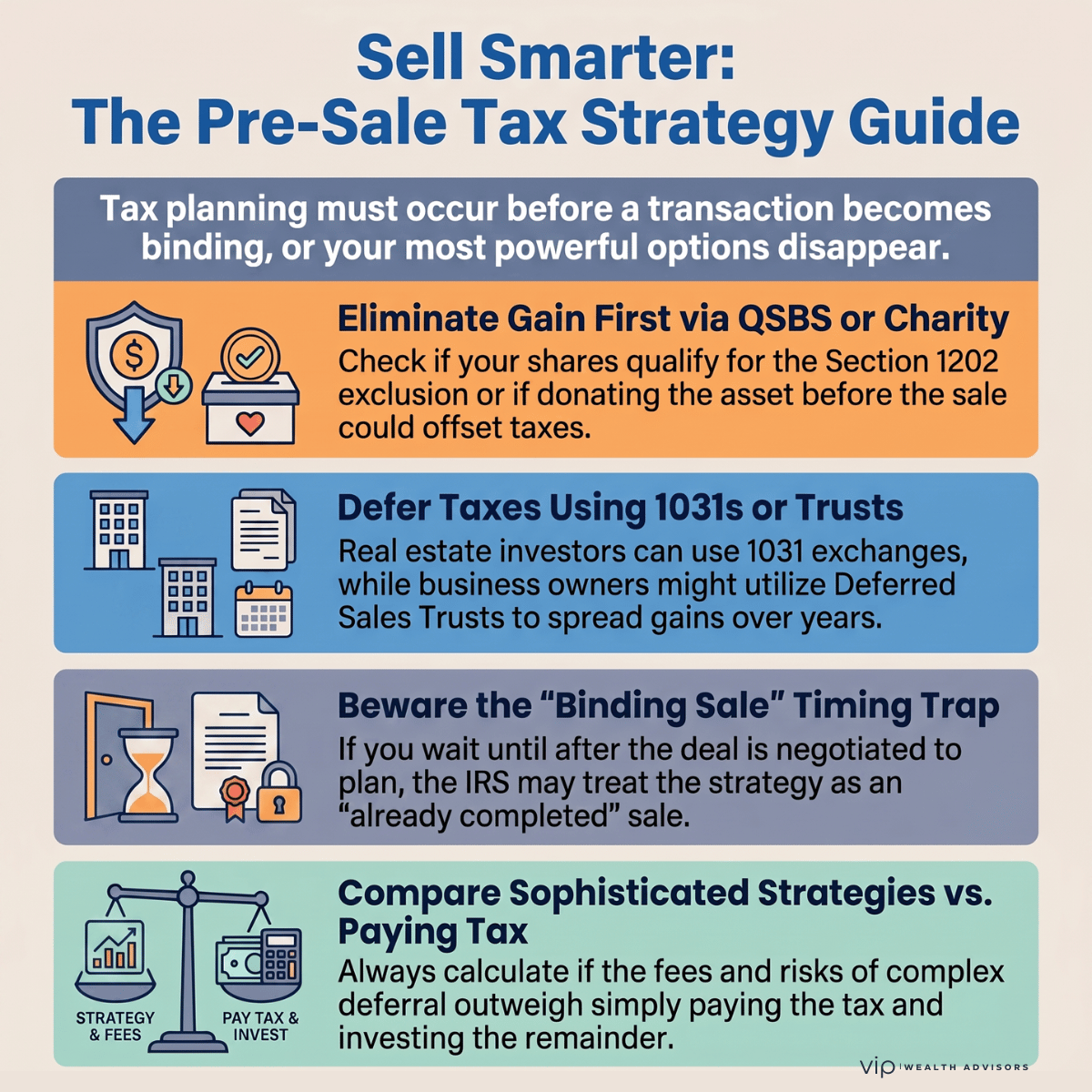
There are generally four questions worth asking before finalizing a sale. First, can any of the gain be eliminated — for example, through the Section 1202 Qualified Small Business Stock exclusion or by donating the asset to charity before the sale. Second, can the remaining gain be deferred — real estate investors often use a Section 1031 exchange, while business owners or private-stock holders may explore a Deferred Sales Trust. Third, can the transaction itself be structured more tax-efficiently? And fourth, how do any of these strategies actually compare to simply paying the tax and investing the remaining proceeds? Critically, most of these strategies must be evaluated before a sale becomes legally binding — once a purchase agreement is signed, the IRS may treat the transaction as already complete, closing off options that were available just days earlier.
What is a Deferred Sales Trust?
A Deferred Sales Trust is a specialized transaction structure designed to use the installment-sale rules under Section 453 of the Internal Revenue Code. The owner generally sells an appreciated asset to an independently administered trust in exchange for a promissory note. The trust can subsequently sell the asset, and the original owner generally recognizes gain as qualifying principal payments are received, provided the transaction is treated as such for tax purposes.
How does a Deferred Sales Trust defer capital gains taxes?
A Deferred Sales Trust attempts to defer capital gains by converting an immediate cash sale into an installment sale. Instead of receiving all of the sale proceeds personally, the seller receives a promissory note from the trust. Under Section 453, qualifying gain is generally recognized as installment payments are received, allowing some of the gain to potentially be spread across future tax years.
Is a Deferred Sales Trust legal?
A Deferred Sales Trust isn't a specific tax structure expressly created or approved by a dedicated provision of the Internal Revenue Code. Rather, it is designed to rely primarily on the existing Section 453 installment-sale rules. Whether a particular transaction receives the intended tax treatment depends heavily on its structure, timing, trustee independence, economic substance, note terms, related-party considerations, and other facts.
How long can you defer capital gains with a Deferred Sales Trust?
There is no fixed number of years for which a Deferred Sales Trust can defer capital gains taxes. The timing of gain recognition generally depends on the terms of the installment obligation and when principal payments are received. Claims that a DST automatically allows capital gains to be deferred for a specific number of decades should therefore be viewed cautiously.
Can a Deferred Sales Trust be used when selling real estate?
Potentially. Appreciated investment real estate can potentially be sold using an installment-sale structure if the transaction and property qualify. However, depreciation recapture, dealer-property rules, debt, related-party provisions, Section 453A, and other tax issues can affect the outcome. Investors should also compare a DST with alternatives such as a Section 1031 exchange and a straightforward taxable sale.
Can a Deferred Sales Trust be used for private-company stock?
Closely held private-company stock may potentially qualify for installment-sale treatment depending on the circumstances. However, shareholders should first investigate whether other provisions, particularly the Section 1202 Qualified Small Business Stock exclusion, could produce a better result. Public and private securities can receive very different treatment under the installment-sale rules.
Can a Deferred Sales Trust be used for publicly traded stock?
Generally, installment-sale treatment isn't available for sales of stock or securities traded on an established securities market. This makes a Deferred Sales Trust generally unsuitable for deferring capital gains from selling ordinary publicly traded stocks. Private or closely held securities require a separate analysis.
What is the difference between a Deferred Sales Trust and a 1031 exchange?
A Deferred Sales Trust seeks tax deferral through the Section 453 installment-sale rules, while a Section 1031 exchange allows qualifying investment or business real estate to be exchanged for qualifying replacement real estate without immediately recognizing all of the gain. A 1031 exchange requires continued investment in real estate and is subject to strict timing requirements. A DST doesn't rely on the Section 1031 replacement-property rules but introduces its own legal, tax, liquidity, and structural risks.
What is the difference between a Deferred Sales Trust and a Delaware Statutory Trust?
Despite sharing the acronym DST, they are different strategies. A Deferred Sales Trust is an installment-sale structure designed to defer recognition of gain. A Delaware Statutory Trust is a legal entity commonly used to own institutional real estate, in which investors purchase beneficial interests. Properly structured Delaware Statutory Trust interests may sometimes qualify as replacement property in a Section 1031 exchange.
What are the risks of a Deferred Sales Trust?
Deferred Sales Trust risks can include the IRS challenging the transaction, loss of intended installment treatment, trustee and credit risk, investment risk, reduced liquidity, administrative and legal costs, Section 453A interest charges, immediate taxation of certain depreciation recapture, trust-level tax considerations, and restrictions on accessing the underlying sale proceeds. These risks should be quantified against the projected benefit of tax deferral.
Is a Deferred Sales Trust better than simply paying capital gains tax?
Not necessarily. A DST should be compared against selling the asset, paying the applicable taxes, and investing the remaining proceeds directly. The appropriate comparison considers taxes, investment returns, legal and trustee costs, Section 453A interest, liquidity, control, risk, and eventual taxation of installment payments. The strategy that produces the largest initial tax deferral isn't automatically the one that produces the greatest long-term after-tax wealth.
When should I start tax planning before selling a business or highly appreciated asset?
Ideally, tax planning should begin well before a sale becomes binding. Some strategies depend on transferring assets, changing ownership, making charitable gifts, establishing residency, or restructuring a transaction before the seller becomes legally committed to a buyer. If a significant liquidity event is possible within the next several years, evaluating the options early can preserve considerably more planning flexibility.
Planning a Major Sale? Start Before the Deal Is Final.
A business sale, real estate transaction, or private-company liquidity event can create a life-changing amount of wealth—and a life-changing tax bill. The most valuable planning often happens while you still have choices.
If you're considering a significant sale, schedule a conversation with VIP Wealth Advisors to evaluate the tax, investment, liquidity, and diversification decisions before the transaction becomes binding.