

Comprehensive financial planning coordinates your investments, taxes, retirement, insurance and estate plan around what you want your money to do, then keeps adjusting as your life changes.
Key Takeaways
- Financial decisions are connected. A choice about investments, taxes, retirement, insurance or estate planning usually ripples into the others.
- Your goals matter as much as the math. The right decision depends on what you're actually trying to accomplish.
- A good plan keeps evolving. Monitoring and updating are built into the financial planning process, not tacked on at the end.
You have an investment portfolio. You’re contributing to your retirement accounts. You have a CPA, your estate documents are signed, and you reviewed your insurance not too long ago. Maybe you’ve already worked through a full financial plan with an advisor.
At some point, it’s fair to ask: Are we done?
Not quite. (Sorry.)
Most people picture financial planning as a project with a finish line. You gather statements, answer a long questionnaire and receive a plan that tells you what to do. Then the binder goes on a shelf.
Life, meanwhile, keeps moving. Income changes and new equity grants vest. Tax laws shift. Children grow up, and parents start to need more help. People change jobs, sell businesses, move to new states, and retire earlier or later than they expected.
Sometimes the numbers barely move while the person changes a lot. What you wanted from your money ten years ago may not be what you want from it today.
That’s why comprehensive financial planning works best as an ongoing process, not a finished product.
What Is Comprehensive Financial Planning?
Comprehensive financial planning is a process that looks at the major areas of your financial life together and makes recommendations based on how they affect one another and your goals. Depending on your situation, that can include investments, cash flow and debt, taxes, insurance, employee benefits, retirement, education and estate planning.
Targeted planning has its place. Sometimes you really do need an answer to one question. But when your finances are complex, one question rarely stays one question for long.
The Financial Planning Process
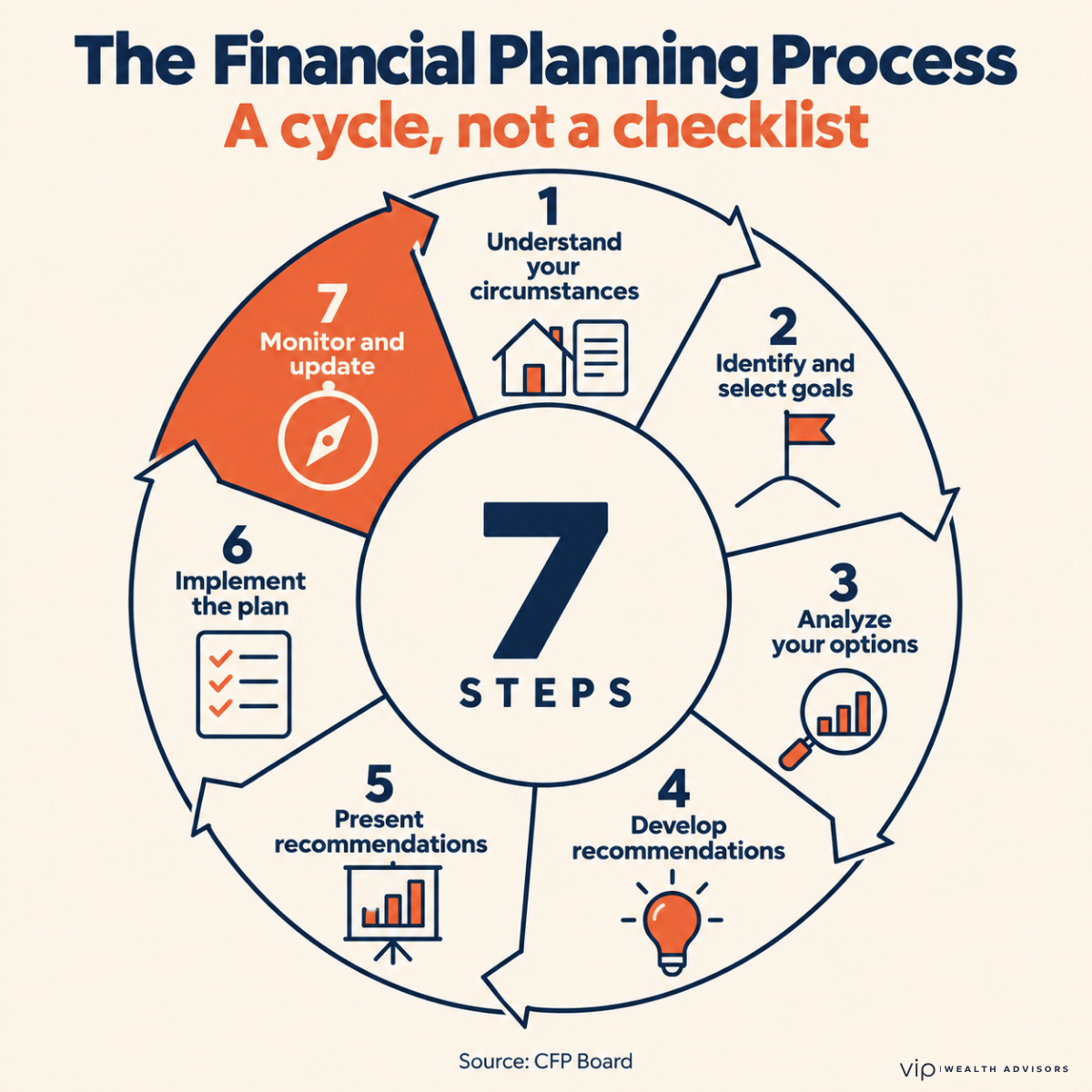
The CFP Board describes financial planning as a seven-step process:
- Understand your personal and financial circumstances.
- Identify and select goals.
- Analyze your current course of action and potential alternatives.
- Develop recommendations.
- Present the recommendations.
- Implement the recommendations.
- Monitor progress and update the plan.
Notice that step seven loops back to step one. The process is designed to keep running.
An Example: Should You Exercise Your Stock Options?
Say you’re an executive deciding whether to exercise stock options. It sounds like an equity compensation question. Then the other pieces start showing up.
Exercising may take a substantial amount of cash. Depending on the type of options, it can trigger taxes. It may leave more of your net worth tied to one company, which pulls your investment strategy into the conversation. A home purchase, an upcoming liquidity event or charitable giving plans can change the answer too.
So the useful question isn't just, “Should I exercise my options?”
It’s closer to, “What would exercising these options mean for everything else we're trying to do?”
That shift is what comprehensive planning is for.
How Do Financial Decisions Affect Each Other?
Your financial life doesn't stay in its lane. Decisions have a habit of bumping into each other:
- Selling a concentrated stock position can reduce investment risk and create a tax bill in the same transaction.
- Retiring early can affect your portfolio, health insurance, cash flow and tax strategy all at once.
- Moving to another state can raise questions about where compensation earned over several years gets taxed.
- Updating your estate plan may uncover beneficiary designations or account titles that no longer make sense.

This is what makes financial planning deceptively complicated. You can have an excellent CPA, a capable estate attorney, solid insurance and a sophisticated portfolio, and still have gaps if each decision is made on its own.
Every piece can work exactly as designed and still not work well together.
The goal isn't just to coordinate a collection of accounts. It's to coordinate them for someone. That's where planning gets interesting.
Why Do Your Goals Matter in Financial Planning?
Because the spreadsheet doesn't always get the final vote.
Picture two executives with the same age, similar incomes and roughly the same net worth. Both carry large mortgages. Both could pay them off tomorrow.
For one, being debt-free would bring an enormous sense of security. The other is perfectly comfortable with the mortgage and would rather keep the money invested.
We can run the same analysis for both, comparing interest rates, expected returns, taxes and liquidity. But the math can’t tell either person how to feel about the answer.
Retirement works the same way. One person wants to stop working the first day the numbers say it's possible. Another could retire at 52 and has zero interest in doing so. Their balance sheets look alike. Their plans shouldn't.
This isn't a soft issue sitting off to the side of the "real" analysis. It changes the analysis.
What Is Your Money Actually For?
It's a simple question that can take a while to answer.
"Retirement" is a goal, but it says little about what you want retirement to look like. "I want to leave money to my children" is useful, yet it raises more questions. How much? When? Is the priority a head start, security, education or a meaningful inheritance?
Even "I want to be financially independent" deserves a follow-up:
What would you do differently if you knew you had enough?
Goals give financial decisions context. Without them, it's easy to spend decades optimizing for a number without ever deciding what the number is supposed to do for you.
How Often Should a Financial Plan Be Updated?
A financial plan should be reviewed at least once a year and revisited whenever something significant changes in your life, your finances or the tax rules that apply to you. The schedule matters less than noticing the change.
Common reasons to revisit a plan include:
- A new job, promotion or change in compensation
- A liquidity event, such as an acquisition, IPO or business sale
- Marriage, divorce, a new child or an inheritance
- A move to a different state
- Supporting an aging parent
- Changes in tax law
- A shift in what you want your money to do
When the Plan Meets Real Life
Imagine your retirement plan assumes you'll work until 60. Then your company is acquired when you're 54.
Your compensation changes. Your equity becomes liquid. Your tax picture looks different. Suddenly you have choices that weren't in the original projection.
The original plan wasn't wrong. It was built on the information available at the time. Now there's new information.
Change doesn't always arrive as a headline event, either. You might reach 60 and realize you still love your work. You might decide to help your children now rather than leave them more later.
Some of the most valuable planning happens here, not when the first plan is written, but when something changes. It means noticing the change, understanding what else it touches and deciding whether the plan should move with it. Then doing it again next time.
Why Does an Ongoing Advisor Relationship Matter?
The tangible parts of planning are valuable: the retirement projection, the tax analysis, the investment strategy, the insurance review and the estate plan. Over time, an advisor also builds something harder to put in a report. Context.
- Why did you decide not to sell that stock three years ago?
- Why does keeping a certain amount of cash matter to you?
- How much do you want to help your children?
- How do you feel about debt?
- What would make you comfortable retiring?
- Which financial risks genuinely keep you up at night?
- What will you give up for a higher expected return, and what won't you?
Those answers matter the next time a decision comes up.
Your advisor doesn't have to do every piece of the work. Your CPA may prepare the return. Your estate attorney may draft the trust. An insurance professional may put coverage in place.
The financial planner's job is to keep asking the bigger question: Do all of these decisions still make sense together, given what you're trying to accomplish?
The value isn't only in answering today's question. It's understanding enough of the bigger picture to see what that answer might change tomorrow.
Financial Planning Is Never Finished
Financial planning will always produce tangible outputs. That's part of the job. But its real value lives beyond any single document or projection. It's having a framework for making the next decision, and the one after that.
Because sooner or later, every financial plan runs into something it couldn’t predict.
Life.
Frequently Asked Questions
What is comprehensive financial planning?
Comprehensive financial planning is a process that considers the major areas of your financial life together rather than one decision at a time. It typically covers investments, taxes, retirement, insurance and risk management, cash flow and debt, employee benefits, education and estate planning, all coordinated around your goals.
What’s the difference between comprehensive and targeted financial planning?
Targeted planning focuses on one or two specific objectives, such as saving for college or deciding when to claim Social Security. Comprehensive planning looks at all relevant areas of your finances and how they interact. A targeted engagement can grow into a comprehensive one as related issues surface.
How often should a financial plan be updated?
Review your financial plan at least once a year, and revisit it whenever something significant changes. Common triggers include a job change, a liquidity event, marriage or divorce, a new child, an inheritance, a move to a new state or changes in tax law.
Is financial planning the same as investment management?
No. Investment management is one part of financial planning. A comprehensive planning relationship also addresses taxes, retirement, insurance, cash flow, employee benefits, education and estate planning, and how decisions in each area affect the others.
Who benefits most from comprehensive financial planning?
People whose finances have several moving parts tend to benefit most. That includes executives with equity compensation, business owners, families approaching a liquidity event, and anyone coordinating decisions across a CPA, an estate attorney and an investment advisor.
Why does financial planning need to be ongoing?
Because the assumptions behind any plan change. Income, family, health, tax law and personal priorities all shift over time. Ongoing planning gives you a way to evaluate each change and decide whether earlier recommendations still make sense.
Want to See How the Pieces of Your Financial Life Fit Together?
If your finances have grown more complex, or you’re not sure the decisions being made in different areas are working together, that’s a great conversation to have.