

A car lease payment is driven mainly by the negotiated selling price, residual value, money factor, and lease term. Understanding those inputs lets you evaluate the real economics instead of negotiating only the monthly payment.
Key Takeaways
- Negotiate the numbers, not the payment. Selling price, fees, incentives, and money factor determine the true cost of a lease.
- Watch the residual and money factor. A higher residual lowers depreciation, while dealer financing markups increase costs.
- Run the numbers before signing. Use our lease calculator to spot markups, estimate taxes, and negotiate with confidence.
- MSRP: The Starting Point
- Negotiated Selling Price
- Residual Value
- Money Factor
- How the Lease Payment Is Calculated
- Adjusted Cap Cost & Down Payments
- Manufacturer Controls vs. Dealer Negotiation
- Why to Negotiate Your Trade Separately
- The Money-Factor Markup Trap
- Reverse-Engineering a Target Payment
- Use the VIP Lease Calculator
- Questions to Ask Before Signing
- Should You Lease or Buy?
- Frequently Asked Questions
Leasing a car can feel needlessly complicated. Dealers talk about monthly payments, money due at signing, residual values, mileage limits, acquisition fees, rebates, money factors, and capitalized cost reductions. By the time they present the numbers, many consumers focus on just one thing: “What is my monthly payment?”
That is usually the wrong place to start. A lease payment is not a mysterious number produced behind the curtain. It is the mathematical result of a handful of inputs. Once you understand those inputs, you can calculate the payment yourself, find room to negotiate with the dealer, spot hidden financing markups, and distinguish a genuinely attractive lease from one with an attractive-looking monthly payment.
At VIP Wealth Advisors, we approach major purchases the same way we approach investments, taxes, and financial planning: understand the economics first, then decide.
For most vehicle leases, the majority of the calculation comes down to MSRP, negotiated selling price, residual value, and money factor. Everything else builds around them.
1. MSRP: The Starting Point
MSRP is the manufacturer’s suggested retail price. For example, assume you are considering a luxury SUV with an MSRP of $131,095. MSRP matters for more than simply establishing the sticker price. It is also typically the number used to calculate the vehicle’s residual value.
That distinction matters because you may negotiate the selling price well below MSRP, but the residual value is usually still calculated using the original MSRP. Suppose the vehicle has a 58% residual:
$131,095 × 58% = $76,035
Even if you negotiate the vehicle down to $125,000, the residual calculation generally does not fall to 58% of $125,000. That works in the lessee’s favor.
2. Negotiated Selling Price: Where Much of Your Leverage Lives
A lease still involves negotiating the car's price. This surprises some consumers because dealers often steer the discussion toward monthly payments rather than the purchase price.
If the vehicle carries a $131,095 MSRP and you negotiate a 5% dealer discount:
$131,095 × 5% = $6,555 discount
Negotiated selling price ≈ $124,540
That lower selling price reduces the depreciation you pay during the lease. This is why negotiating a lease based solely on monthly payment can be dangerous.
A dealer could lower your payment in several ways:
- reduce the selling price,
- ask you for a larger down payment,
- extend the lease,
- change the mileage allowance,
- apply a rebate,
- or manipulate the financing component.
Those are not economically equivalent. You want to know exactly how the payment was created.
3. Residual Value: What the Leasing Company Thinks the Car Will Be Worth Later
The residual value is the leasing company’s predetermined estimate of what the vehicle will be worth at the end of the lease term. It is usually expressed as a percentage of MSRP.
MSRP: $131,095
Residual percentage: 58%
Residual value: $131,095 × .58 = $76,035
The leasing company, not the dealership, generally sets residual percentages. They may vary based on vehicle model, trim, lease length, annual mileage, and the current lease program.
A 36-month lease with 7,500 miles per year may carry a higher residual than a 36-month lease with 15,000 miles per year because the lower-mileage vehicle is expected to be worth more at lease-end. All else equal, the higher the residual, the lower your lease payment.
Why? Because you are primarily paying for the portion of the vehicle’s value you consume during the lease. If the vehicle starts at an adjusted cap cost of $124,540 and ends with a residual value of $76,035, the depreciation being financed through the lease is approximately $48,505.
4. Money Factor: The Lease Version of an Interest Rate
The money factor is the financing component of a lease. Instead of quoting a familiar APR such as 5.5%, leasing companies often use a decimal that looks something like 0.00200.
To convert a money factor into an approximate APR, multiply it by 2,400.
| Money factor | Approximate APR |
|---|---|
| .00125 | 3.0% |
| .00167 | 4.0% |
| .00208 | 5.0% |
| .00250 | 6.0% |
Understanding the money factor matters because dealers may mark up the lender’s base money factor. Suppose the leasing company’s base money factor is 0.00175, but the dealer quotes 0.00225. The difference may look tiny. It is not. On a $100,000-plus vehicle, that markup can add thousands of dollars to the total lease cost.
“What is the lender’s base money factor, and are you marking it up?”
How the Lease Payment Is Actually Calculated
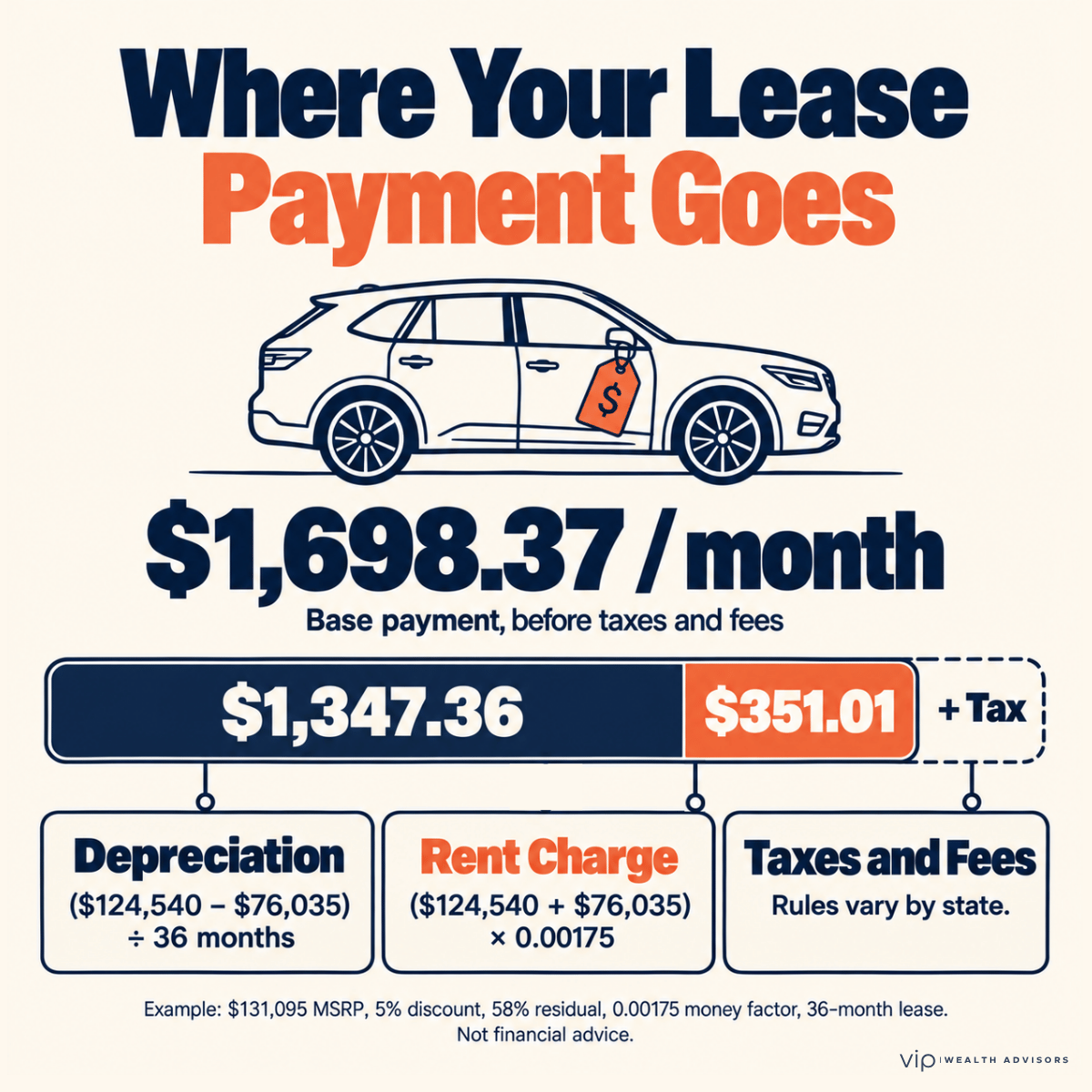
At its core, a lease payment contains two major components: depreciation and the finance charge, sometimes called the rent charge.
Step 1: Calculate Monthly Depreciation
Assume an adjusted cap cost of $124,540, a residual value of $76,035, and a 36-month lease term.
Total depreciation: $124,540 − $76,035 = $48,505
Monthly depreciation: $48,505 ÷ 36 = $1,347.36
This is the portion of the vehicle’s value you consume each month.
Step 2: Calculate the Monthly Rent Charge
Assume a money factor of 0.00175. The standard lease formula is:
(Adjusted Cap Cost + Residual Value) × Money Factor
($124,540 + $76,035) × .00175 ≈ $351.01 per month
Why are the cap cost and residual added together? Because the leasing company has capital tied up in the vehicle throughout the lease. The balance begins near the adjusted cap cost and gradually declines toward the residual value. The formula simplifies financing costs by applying them to the average capital outstanding over the lease period.
Step 3: Add Depreciation and Rent Charge
Monthly depreciation: $1,347.36
Monthly rent charge: $351.01
Estimated base payment: $1,698.37
Before applicable taxes and certain fees, your monthly lease payment is now very close to $1,700. There is no magic. It is simply math.
Your Lease Payment, Broken Down
In our example, about 79% of the $1,698.37 base payment covers depreciation, the value you use up during the lease. The rest is the rent charge for financing. Taxes and fees are added on top, depending on your state.
What Is Adjusted Cap Cost?
The capitalized cost is essentially the amount being financed through the lease. It begins with the negotiated selling price and may then be adjusted for items such as acquisition fees, certain taxes, warranties or products rolled into the lease, rebates, incentives, trade equity, and cap-cost reductions.
Suppose your selling price is $124,540 and the lender charges a $995 acquisition fee that you roll into the lease. Your adjusted cap cost could become $125,535. That higher cap cost modestly increases the monthly payment.
What Is a Cap-Cost Reduction?
A cap-cost reduction is essentially a down payment on a lease. Suppose the vehicle has an adjusted cap cost of $125,000. If you put $5,000 down, the amount used to calculate the lease drops to approximately $120,000.
Your monthly payment falls. But you did not necessarily improve the deal. You simply prepaid part of the lease.
A $1,599 monthly payment with $7,500 effectively prepaid over 36 months adds about $208 per month, making the economic burden closer to $1,807 per month.
This is why we generally prefer analyzing leases with little or no cap-cost reduction. The cleanest lease comparison is often zero cap-cost reduction and minimal required cash due at signing.
Cash Due at Signing Is Not the Same as a Down Payment
Cash due at signing may include the first month’s payment, acquisition fee, registration, title fees, taxes, and a security deposit if applicable. Those are different from cap-cost reduction.
Ask: “How much of the cash due at signing is actual cap-cost reduction?”
If the answer is several thousand dollars, the monthly payment may be artificially low.
Manufacturer Controls vs. Dealer Negotiation
Understanding who controls each input makes lease negotiation much easier.
| Input | Who usually controls it? | What to know |
|---|---|---|
| MSRP | Manufacturer | Set by the manufacturer. |
| Residual percentage | Leasing company | Usually fixed for the program. |
| Base money factor | Lender | The dealer may quote a higher marked-up rate. |
| Factory incentives and rebates | Manufacturer / lender program | Program-specific. |
| Selling price | Dealer negotiation | Often the largest source of leverage. |
| Money-factor markup | Dealer negotiation | Ask for the lender’s buy rate. |
| Dealer fees and add-ons | Dealer | Some may be negotiable. |
| Trade value | Dealer negotiation | Negotiate separately from the lease. |
| Cap-cost reduction | You | Your choice; it lowers payment by prepaying lease cost. |
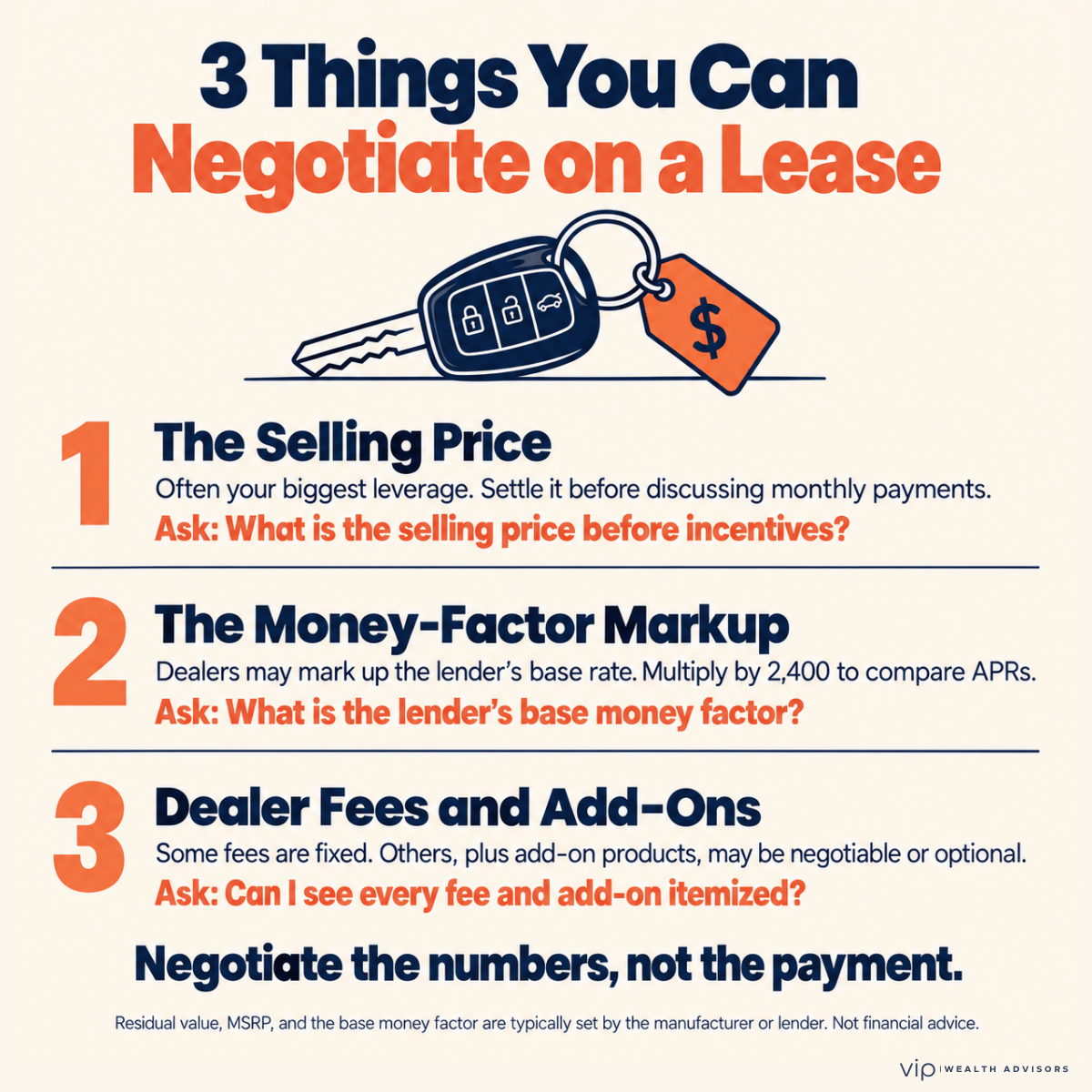
Where You Have Room to Negotiate
Some lease terms are set before you walk in. These three are where your questions can make a real difference to what you pay.
Why You Should Negotiate the Car Before Discussing Your Trade
If you have a trade-in, treat it as a completely separate transaction. Suppose the dealer tells you, “We can give you an extra $4,000 for your trade.” That sounds great. But if the dealer simultaneously removes a $4,000 discount from the new vehicle, nothing improved.
Establish the new vehicle selling price, lease money factor, manufacturer incentives, and trade-in value independently. Only after each is established should you combine them.
The Money-Factor Markup Trap
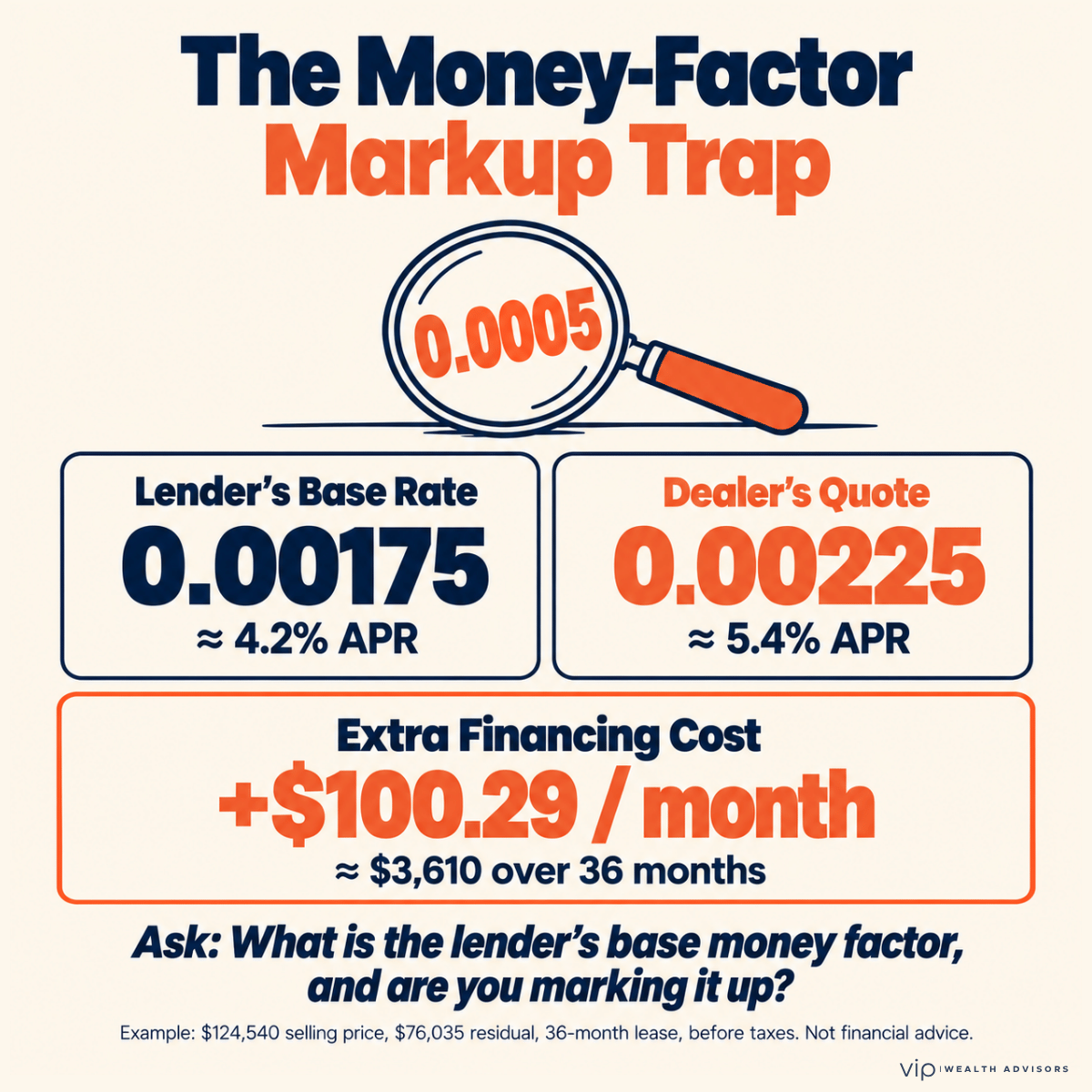
Suppose a leasing company offers a base money factor of 0.00175, or approximately 4.2% APR. The dealer quotes 0.00225, or approximately 5.4% APR.
On a six-figure vehicle, that difference can materially change the total cost. This is why the calculator below allows you to enter both the lender’s base money factor and the dealer-quoted money factor.
It can then show the monthly markup cost and total additional financing cost over the lease. A microscopic number suddenly becomes very tangible.
Reverse-Engineering Your Target Payment
One of the most powerful ways to negotiate a lease is to work backward. Instead of asking, “Can you get my payment to $1,700?” you can calculate exactly what selling price is required to produce a $1,700 payment.
Assume:
- MSRP: $131,095
- Residual: 58%
- Money factor: .00175
- Lease term: 36 months
- Target payment: $1,700
Using the lease formulas, the required adjusted cap cost is approximately $124,600. That means the vehicle needs to be discounted by approximately $6,500, or roughly 5% off MSRP.
“I need approximately a 5% dealer discount, the lender’s base money factor, no cap-cost reduction, and all applicable incentives.”
That is considerably more sophisticated than saying, “Can you get me to $1,700 per month?” The first statement demonstrates that you understand the economics. The second invites the dealer to manipulate the inputs.
What a Tiny Markup Really Costs
A money-factor markup of just 0.0005 looks insignificant on paper. In our example, it adds about $100 per month, or roughly $3,610 over a 36-month lease, before taxes.
Use the VIP Wealth Advisors Lease Calculator
Now put the math to work. Enter the figures from the dealer worksheet into the calculator below to estimate the payment, isolate depreciation and rent charge, compare the dealer’s quoted money factor with the lender’s base rate, and test how taxes and cash due at signing affect the economics.
Start with Calculate lease to audit a proposal. Then switch to Target payment to estimate the selling price and discount needed to reach a payment goal without hiding the economics in a larger down payment.
Tax methodology last reviewed: October 17, 2026. State and local vehicle-tax rules can change, and the calculator is designed as an educational estimate rather than a tax opinion.
The calculator includes inputs for MSRP, dealer discount, incentives and rebates, residual percentage, money factor, lease term, acquisition and rolled-in fees, cap-cost reduction, state tax assumptions, and cash due at signing.
It estimates negotiated selling price, adjusted cap cost, residual value, monthly depreciation, monthly finance charge, money-factor APR equivalent, estimated taxes, total lease payment, and effective monthly cost.
The reverse mode lets you enter a target payment and solve for the approximate selling price required to reach it. That turns the calculator into a negotiation tool rather than simply a payment estimator.
Questions to Ask Before Signing a Lease
Before signing, ask the dealer to show you the following numbers in writing:
- What is the MSRP?
- What is the negotiated selling price?
- What dealer discount am I receiving?
- What incentives or rebates are being applied?
- What is the residual percentage?
- What is the residual dollar amount?
- What is the base money factor?
- Is the dealer marking up the money factor?
- What is the adjusted cap cost?
- How much cash is due at signing?
- How much of that amount is cap-cost reduction?
- What is the annual mileage allowance?
- What are the excess mileage charges?
- What acquisition, disposition, or dealer fees apply?
- What is the total amount I will pay over the lease?
If the dealer cannot or will not clearly provide these figures, you do not yet have enough information to evaluate the transaction.
Should You Lease or Buy?
Understanding lease math does not necessarily mean leasing is the best decision.
| Leasing may make sense when… | Buying may make more sense when… |
|---|---|
| You prefer a new vehicle every few years. | You plan to keep the vehicle for many years. |
| Technology changes quickly. | Financing rates are attractive. |
| The residual is strong. | The lease money factor is high. |
| The manufacturer is subsidizing the money factor. | The residual is weak. |
| The vehicle depreciates quickly. | You drive substantially more than typical lease mileage limits. |
| You value predictable ownership periods and warranty coverage. | You want long-term ownership flexibility. |
The right answer depends on the economics of the individual vehicle and your broader financial plan.
Negotiate the Economics, Not the Payment
The monthly payment should be the result of your analysis, not the starting point. Once you understand MSRP, selling price, residual value, and money factor, most of the mystery disappears. You can see exactly how much of your payment represents depreciation, how much represents financing, where the dealer has discretion, and where the leasing company has already set the terms.
That changes the conversation. Instead of asking the dealer to “get you to a payment,” you can negotiate the specific economic inputs that determine the payment.
A sophisticated lease negotiation is not about making the monthly payment look small. It is about understanding exactly what you are paying, why you are paying it, and whether the economics make sense within the rest of your financial plan.
Frequently Asked Questions About Car Leases
What is the most important number when negotiating a lease?
The negotiated selling price is one of the most important variables because it directly affects how much depreciation you finance. However, a low selling price can be offset by a higher money factor, so you should evaluate both together.
Is the residual value negotiable?
Usually no. The leasing company typically sets the residual percentage based on the vehicle, lease term, and mileage allowance.
Can the money factor be negotiated?
The lender’s base money factor is generally fixed, but a dealership may mark it up. You can negotiate away the dealer markup by asking for the lender’s base or buy-rate money factor.
Should I put money down on a lease?
Generally, we prefer minimizing cap-cost reductions. Putting money down lowers the monthly payment but largely represents prepaid lease expense rather than an improvement in the underlying economics.
What is a good money factor?
It depends on prevailing interest rates and the specific manufacturer’s lease program. Multiply the money factor by 2,400 to estimate the APR equivalent and compare it with other financing options.
Why is the residual calculated from MSRP instead of the negotiated price?
The residual represents the leasing company’s projected future value of the vehicle, and lease programs typically base that estimate on MSRP rather than the discounted selling price. This can benefit the lessee when the vehicle is negotiated well below MSRP.
What is the difference between the selling price and cap cost?
The selling price is the negotiated vehicle price. The capitalized cost starts with that price and is adjusted for fees, incentives, rebates, rolled-in costs, and cap-cost reductions.
How can I tell whether a lease advertisement is actually a good deal?
Convert all upfront payments into an effective monthly cost. For example, a $1,599 payment with $7,500 due at signing may be economically closer to an $1,800-plus monthly lease once you spread the upfront payment across the lease term.
Is leasing always more expensive than buying?
No. Lease economics depend on depreciation, residual values, interest rates, manufacturer incentives, taxes, and how long you intend to own the vehicle. Some manufacturers heavily subsidize leases. Others offer much better financing incentives.
Want a Second Set of Eyes on a Major Financial Decision?
A vehicle lease may be one line item in a much bigger financial picture. If you want help evaluating how a large purchase fits alongside taxes, investments, cash flow, and long-term goals, we can help you look at the decision in context.