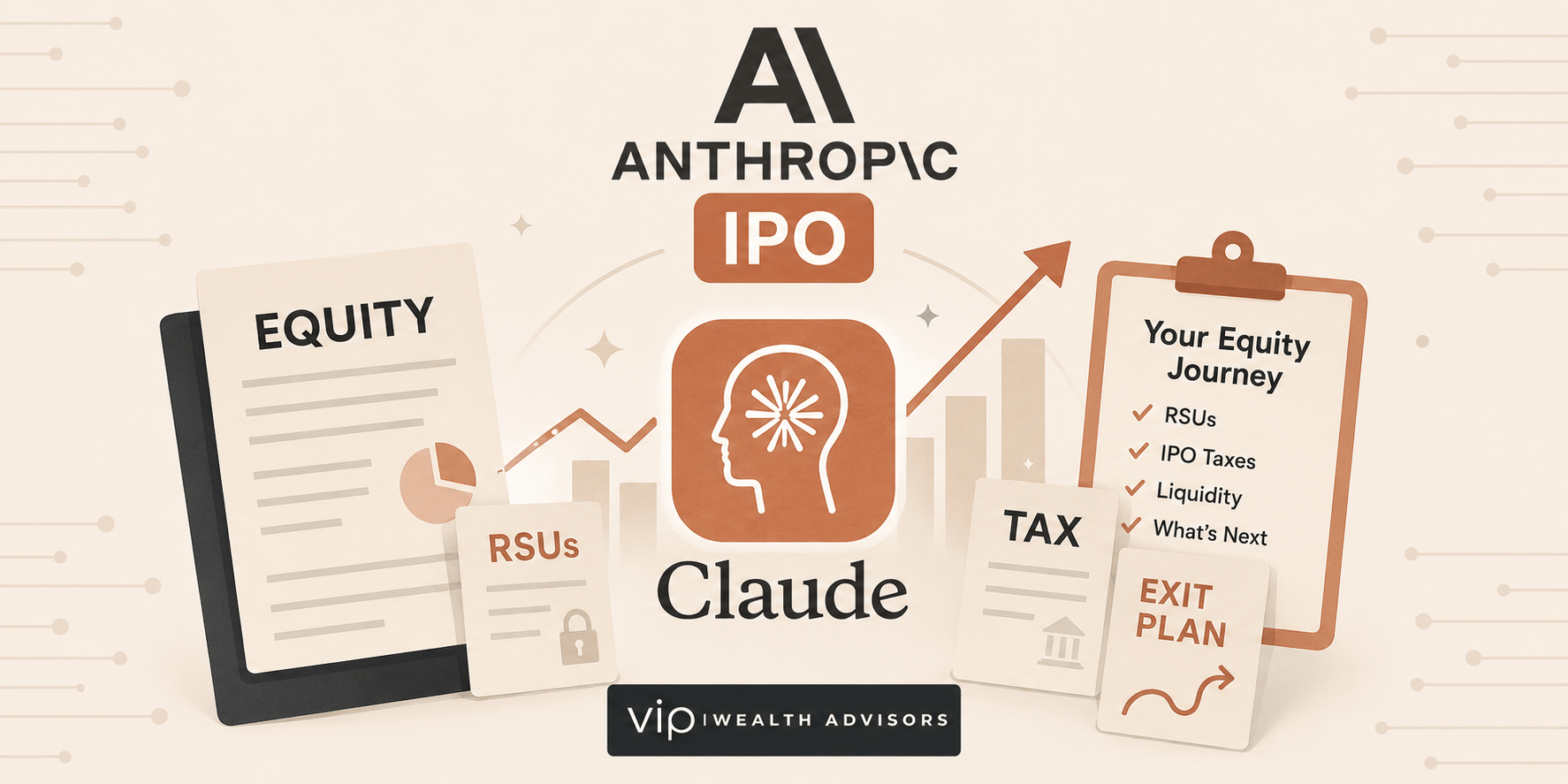
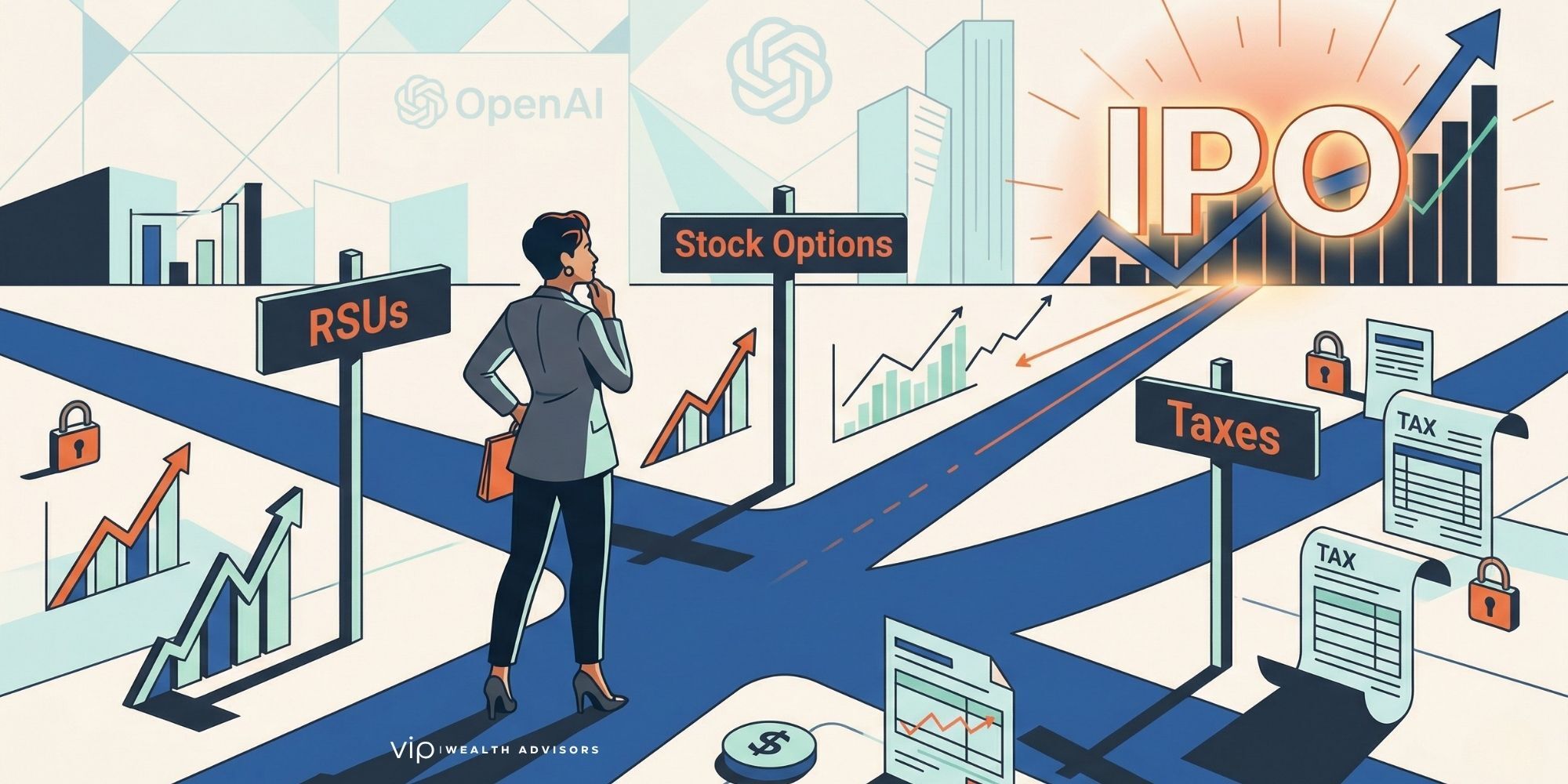
The OpenAI IPO could create significant paper wealth for employees, but the real financial outcome depends on understanding your equity type, planning for taxes, navigating lockups, and making disciplined post-IPO decisions.
Key Takeaways
- The OpenAI IPO could be a life-changing liquidity event, but the biggest financial risks often come after the IPO rather than during it.
- OpenAI employees may hold very different forms of equity, including legacy Profit Participation Units (PPUs), RSUs, and stock options, which can lead to very different outcomes.
- RSU tax timing, option exercise strategy, AMT exposure, and lockup restrictions can all materially affect your after-tax wealth.
- Employees need to prepare for concentration risk, withholding shortfalls, and the possibility of owing taxes before they can access liquidity.
- The most important planning decisions happen before and after the IPO, when there is still time to model scenarios and act deliberately.
The potential OpenAI IPO isn’t just another tech listing. It has all the ingredients of a once-in-a-decade liquidity event.
If you’re an OpenAI employee, you may already be sitting on significant paper wealth. For some, that number may be large enough to change the trajectory of your life. Financial independence may suddenly feel within reach.
But here’s the reality most people don’t say out loud:
The IPO itself isn’t the hard part. The decisions that follow are.
And those decisions, if handled incorrectly, can cost you millions in taxes, missed opportunities, or irreversible mistakes.
This article breaks down what OpenAI employees likely have in terms of equity compensation, how it may behave during an IPO, and the key planning decisions that matter most.
Why the OpenAI IPO Could Be a Life-Changing Financial Event
OpenAI has already seen massive valuation growth through private funding rounds and employee tender offers. That means many employees are no longer dealing with hypothetical upside. They’re dealing with real, measurable wealth.
An IPO changes everything:
- Illiquid equity becomes (eventually) liquid
- Paper wealth becomes taxable income
- Long-term potential becomes immediate decision-making
For many employees, this may be the single most important financial moment of their lives.
And yet, most people approach it without a clear strategy.
Why OpenAI Equity Is More Complicated Than a Typical Tech IPO
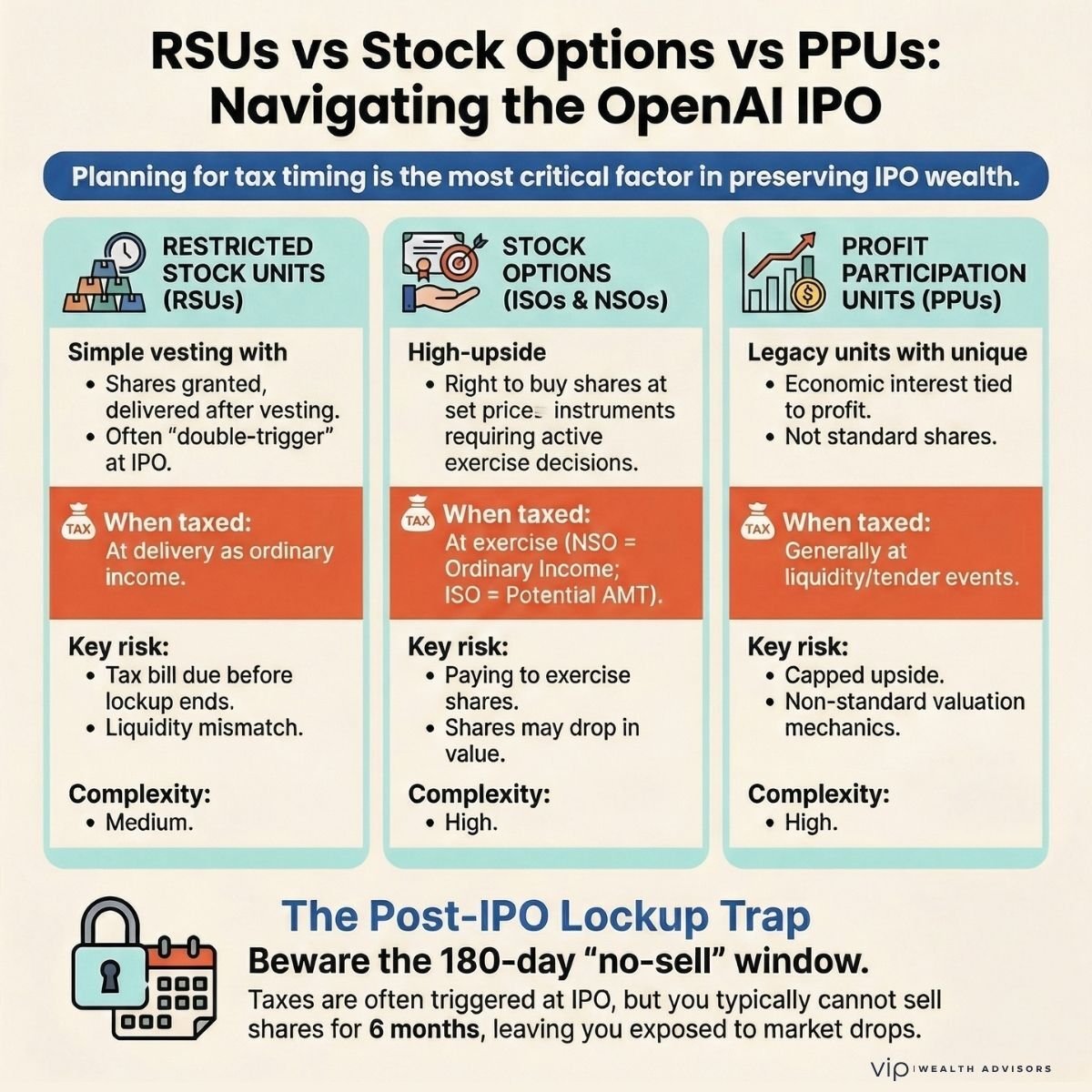
Unlike a traditional startup, OpenAI has undergone multiple structural changes.
Historically, employees were granted Profit Participation Units (PPUs) tied to a capped-profit structure. More recently, evidence suggests a shift toward Restricted Stock Units (RSUs) for newer employees, with stock options available in certain cases.
That means:
Two employees at OpenAI may have completely different financial outcomes depending on when they joined and how they were compensated.
This is not a one-size-fits-all situation.
Understanding OpenAI’s Legacy Equity: Profit Participation Units (PPUs)
Earlier OpenAI employees were often granted PPUs rather than traditional stock.
At a high level, PPUs:
- Represent an economic interest rather than standard equity
- Are tied to a capped return structure
- Typically, vests over time
- Have historically relied on liquidity events (like tender offers or an IPO)
This structure introduces unique considerations:
- Your upside may not be unlimited
- Liquidity timing may differ from traditional shares
- Valuation mechanics may not be straightforward
If you hold PPUs, the key question isn’t just “what are they worth?”
It’s: “How and when do I actually realize that value?”
OpenAI’s Shift to RSUs: What Newer Employees Need to Know
More recent hires appear to be receiving RSUs, which are more common in later-stage companies.
RSUs are simpler on the surface:
- You don’t need to purchase shares
- They vest over time
- They are taxed as ordinary income when delivered
But the real complexity is under the surface.
Single-Trigger vs. Double-Trigger RSUs (Critical Distinction)
There are two main types of RSU structures:
- Single-trigger: Shares are delivered as they vest
- Double-trigger: Shares are delivered only after both vesting and a liquidity event (like an IPO)
Public information does not clearly confirm which structure OpenAI uses.
Why this matters:
- Tax timing: You may owe taxes before you can sell
- Liquidity mismatch: You could be taxed without having cash available
What happens to RSUs when a company goes public?
If RSUs are single-trigger, they are typically taxed as ordinary income when they vest.
If RSUs are double-trigger, vesting alone is not enough. Shares are delivered only after a liquidity event, such as an IPO. At that point, they are taxed when settled.
This distinction can dramatically impact both your tax bill and your cash flow.
Stock Options at OpenAI: What Employees Need to Understand
Stock options are part of OpenAI’s broader equity compensation structure, particularly for certain employees and grant periods. While not every employee will have options, those who do face a very different set of decisions than RSU holders.
The first step is understanding what type of options you have, because the tax treatment and planning strategy depend entirely on this distinction.
Incentive Stock Options (ISOs)
ISOs receive favorable long-term capital gains treatment if specific holding requirements are met. However, they can trigger Alternative Minimum Tax (AMT) at the time of exercise, even if you have not sold the shares.
Non-Qualified Stock Options (NSOs)
NSOs are simpler but less tax-efficient. The spread between the exercise price and the fair market value at exercise is taxed as ordinary income, regardless of whether you sell the shares.
The Decisions That Matter Most If You Hold Options
If you have stock options, your outcome will be driven by a small number of high-impact decisions:
Exercise timing determines your tax exposure
Exercising early may reduce future taxes if the stock appreciates, but it introduces risk and potential upfront tax liability.
AMT exposure must be modeled in advance
ISO exercises can create significant tax obligations without any liquidity, making planning essential.
Post-IPO price movement changes everything
A higher stock price increases both the opportunity cost and the tax cost. Waiting can be expensive. Acting too early can also be costly.
Liquidity constraints cannot be ignored
Exercising options requires capital. Without a clear plan, employees can find themselves asset-rich but cash-poor.
Stock options are not passive. They require active decision-making.
Handled correctly, they can significantly enhance long-term wealth.
Handled poorly, they can create unnecessary taxes, risk, and missed opportunities.
Understanding your option type and planning your exercise strategy before a liquidity event is critical.
The IPO Timeline: What Actually Happens to Your Equity
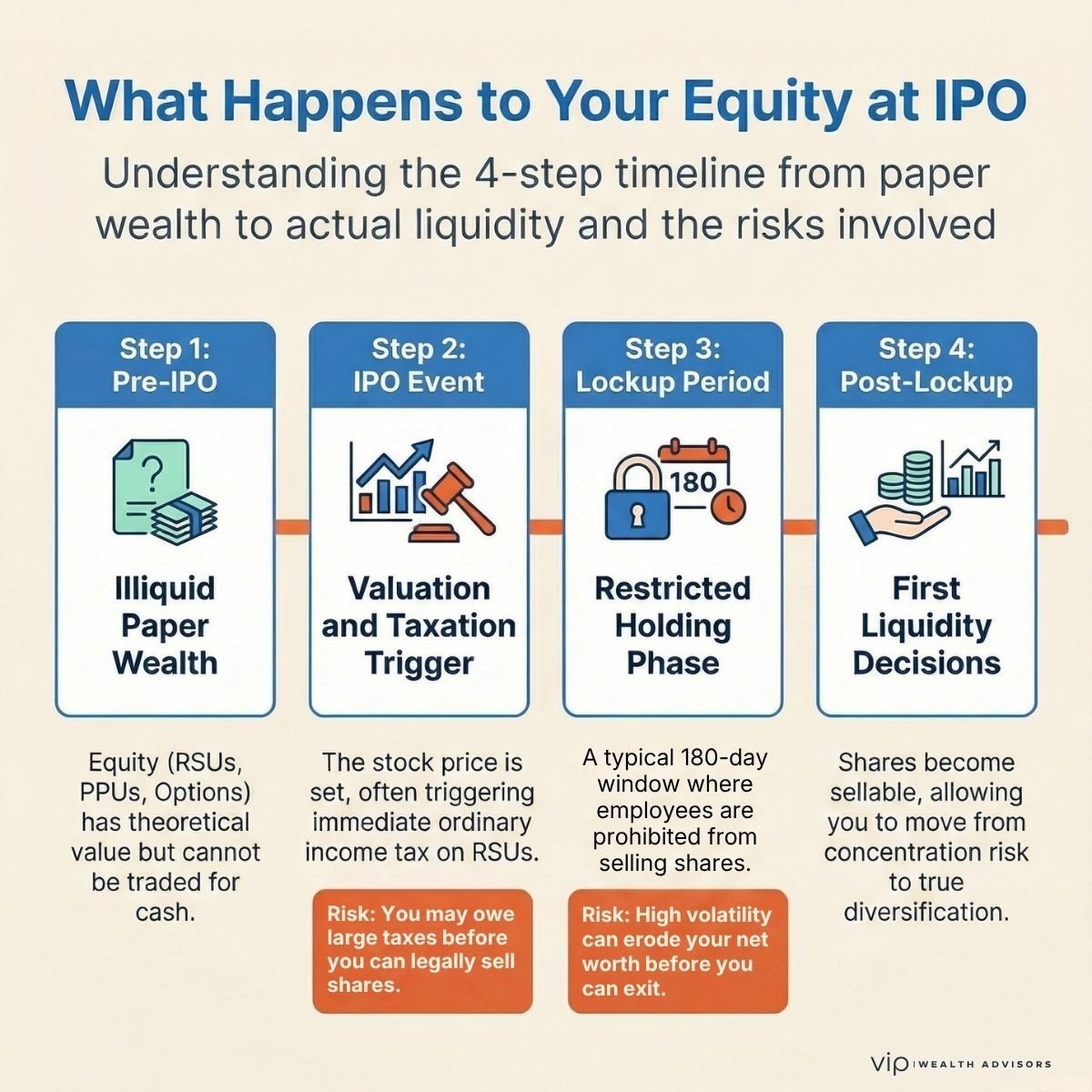
Understanding the sequence matters more than most people realize.
Typical flow:
- S-1 filing – public disclosure begins
- IPO pricing – shares are priced and begin trading
- Lockup period – employees cannot sell (typically ~180 days)
- First liquidity window – employees can finally sell shares
Here’s the key insight:
Your net worth may increase dramatically on paper… while your ability to access cash remains zero.
The Lockup Period Trap (Where Many Employees Get Burned)
The lockup period is one of the most misunderstood risks.
During this time:
- You cannot sell shares
- The stock price may move significantly
- Emotions run high
Many employees assume:
“I’ll just sell after the IPO.”
But reality looks more like:
- The price peaks before you can sell
- Volatility increases
- Decision-making becomes reactive
The biggest risk isn’t the IPO. It’s what happens during the lockup.
Taxes: The Part No One Is Fully Prepared For
RSUs
- Taxed as ordinary income when delivered
- Withholding may be insufficient
Options
- ISOs → potential AMT exposure
- NSOs → ordinary income at exercise
Key Risk
You may owe a large tax bill even if you haven't sold any shares.
How are RSUs taxed at IPO?
RSUs are generally taxed as ordinary income when they are vested & delivered (not necessarily when the IPO occurs).
If shares are delivered at or after the IPO, the value at that time determines the taxable income.
Additional gains after that point are taxed as capital gains.
The Concentration Risk Problem
Most employees underestimate this.
You are already exposed to OpenAI in multiple ways:
- Your income
- Your career
- Your equity
After the IPO, that exposure can become extreme.
You don’t just work at OpenAI. You may be financially dependent on it.
That’s not diversification. That’s concentration risk.
The Financial Independence Illusion
This is where reality and perception diverge.
Seeing a large number on paper:
- $2M
- $5M
- $10M+
Does not automatically mean:
- You can retire
- You’re financially secure
- You’ve “made it.”
Why?
- Taxes reduce the real number
- Market volatility impacts timing
- Lifestyle decisions compound quickly
Wealth is not the number. It’s what remains after decisions are made.
A Pre-IPO Checklist for OpenAI Employees
If you’re approaching a liquidity event, these are the fundamentals:
- Identify your equity type (PPU, RSU, options)
- Understand your vesting and liquidity timeline
- Model tax scenarios in advance
- Prepare for potential withholding gaps
- Plan for the lockup period
- Define a diversification strategy
- Avoid reactive decision-making
Simple checklist. High stakes.
The Most Important Decision Happens Before the IPO
The IPO will get the headlines.
But the real outcome is determined by what you do before and after it.
Do you understand your equity?
Do you understand your taxes?
Do you have a strategy?
Because once the IPO happens, the clock starts.
And decisions made under pressure are rarely the best ones.
Final Thought
The OpenAI IPO has the potential to create significant wealth for employees.
But wealth creation and wealth preservation are not the same thing.
This is not just a moment. It’s a transition:
- From employee to investor
- From accumulation to decision-making
- From potential to permanence
And navigating that transition correctly is what ultimately determines the outcome.
Frequently Asked Questions: OpenAI IPO, Equity Compensation, and Taxes
What happens to OpenAI employee equity when the company goes public?
When OpenAI goes public, employee equity does not automatically convert into cash. Instead, it becomes publicly tradable stock, typically subject to a lockup period. The exact outcome depends on the type of equity you hold, such as RSUs, stock options, or legacy Profit Participation Units (PPUs).
Can OpenAI employees sell their shares immediately after the IPO?
No. Most employees are subject to a lockup period, usually around 180 days after the IPO. During this time, employees cannot sell their shares, even though the stock is publicly traded.
What is an IPO lockup period?
An IPO lockup period is a restriction that prevents employees and insiders from selling shares for a set period, typically 180 days after the company goes public. This helps stabilize the stock price during the early trading period.
How are RSUs taxed at IPO?
RSUs are taxed as ordinary income when they are delivered to the employee, not necessarily when the IPO occurs. The taxable amount is based on the fair market value of the shares at the time of delivery. Any additional gains after that are taxed as capital gains.
What happens to RSUs when a company like OpenAI goes public?
If RSUs are structured as single-trigger, they may be delivered as they vest. If they are double-trigger, they are delivered only after both vesting and a liquidity event, such as an IPO. This determines when taxes are owed and when shares become available.
Do OpenAI employees receive RSUs or stock options?
Public information suggests that newer OpenAI employees may receive RSUs, while some employees may also hold stock options. Earlier employees may hold Profit Participation Units (PPUs), which are unique to OpenAI’s earlier structure.
Are stock options taxed at IPO?
No. Stock options are not taxed at the time of the IPO. Instead, taxation depends on when you exercise the options and when you sell the shares. Non-qualified stock options (NSOs) are taxed at exercise, while incentive stock options (ISOs) may trigger alternative minimum tax (AMT).
Should you exercise stock options before an IPO?
It depends. Exercising before an IPO may reduce future taxes if the stock price increases, but it can also create risk and potential tax exposure, including AMT for ISOs. This decision should be modeled carefully based on your specific situation.
What are Profit Participation Units (PPUs) at OpenAI?
PPUs are a form of economic interest used in OpenAI’s earlier compensation structure. Unlike traditional stock, they may be tied to a capped return and depend on liquidity events, such as tender offers or an IPO, to realize value.
How do taxes work for OpenAI employees after an IPO?
Taxes depend on the type of equity:
- RSUs are taxed as ordinary income when delivered
- NSOs are taxed on exercise
- ISOs may trigger AMT and are taxed upon sale
Employees may face large tax bills even if they have not sold shares yet.
What is the biggest tax risk for employees at IPO?
The biggest risk is a mismatch between taxation and liquidity. You may owe taxes when shares vest or are delivered, even if you are unable to sell those shares due to lockup restrictions.
Should OpenAI employees sell their shares after the IPO?
There is no one-size-fits-all answer. Selling reduces concentration risk and locks in gains, while holding maintains exposure to potential upside. The right decision depends on your financial goals, tax situation, and overall portfolio.
What is concentration risk, and why does it matter?
Concentration risk occurs when a large portion of your wealth is tied to a single company. For OpenAI employees, this includes salary, career, and equity. High concentration increases financial risk if the stock declines.
Does an IPO mean financial independence for employees?
Not necessarily. While an IPO may create significant wealth on paper, taxes, market volatility, and spending decisions all impact whether that wealth translates into long-term financial independence.
What should OpenAI employees do before the IPO?
Before an IPO, employees should:
- Understand their equity type
- Model potential tax outcomes
- Plan for lockup restrictions
- Develop a diversification strategy
- Avoid making reactive decisions under pressure
What is the most important decision OpenAI employees will face?
The most important decisions happen before and after the IPO, not during it. Understanding your equity, planning for taxes, and having a clear strategy will ultimately determine your financial outcome.
Planning around OpenAI equity before an IPO can materially change your after-tax outcome.
If you want help pressure-testing your RSUs, options, tax exposure, lockup strategy, and diversification plan before decisions get rushed, start the conversation now.