
A potential SpaceX IPO could create generational wealth for employees, but only if equity, tax, and liquidity decisions are handled strategically.
Key Takeaways
- SpaceX equity can create massive upside, but taxes and timing determine how much you actually keep.
- RSUs, ISOs, NSOs, and ESPPs all trigger taxes differently and require coordinated planning.
- Pre-IPO liquidity events are limited and strategic participation matters.
- Concentration risk is one of the biggest hidden dangers post-IPO.
- Employees who plan early consistently retain more of their equity wealth.
SpaceX may be on the brink of a historic transition. A potential initial public offering (IPO) in 2026 could transform private equity stakes into liquid wealth for thousands of employees, but it also introduces complex tax, timing, and diversification decisions that can profoundly impact your financial future.
This article walks through the latest IPO developments, breaks down the types of equity compensation at SpaceX, and offers actionable insights for planning ahead.
1. IPO on the Horizon — What’s Happening Now?
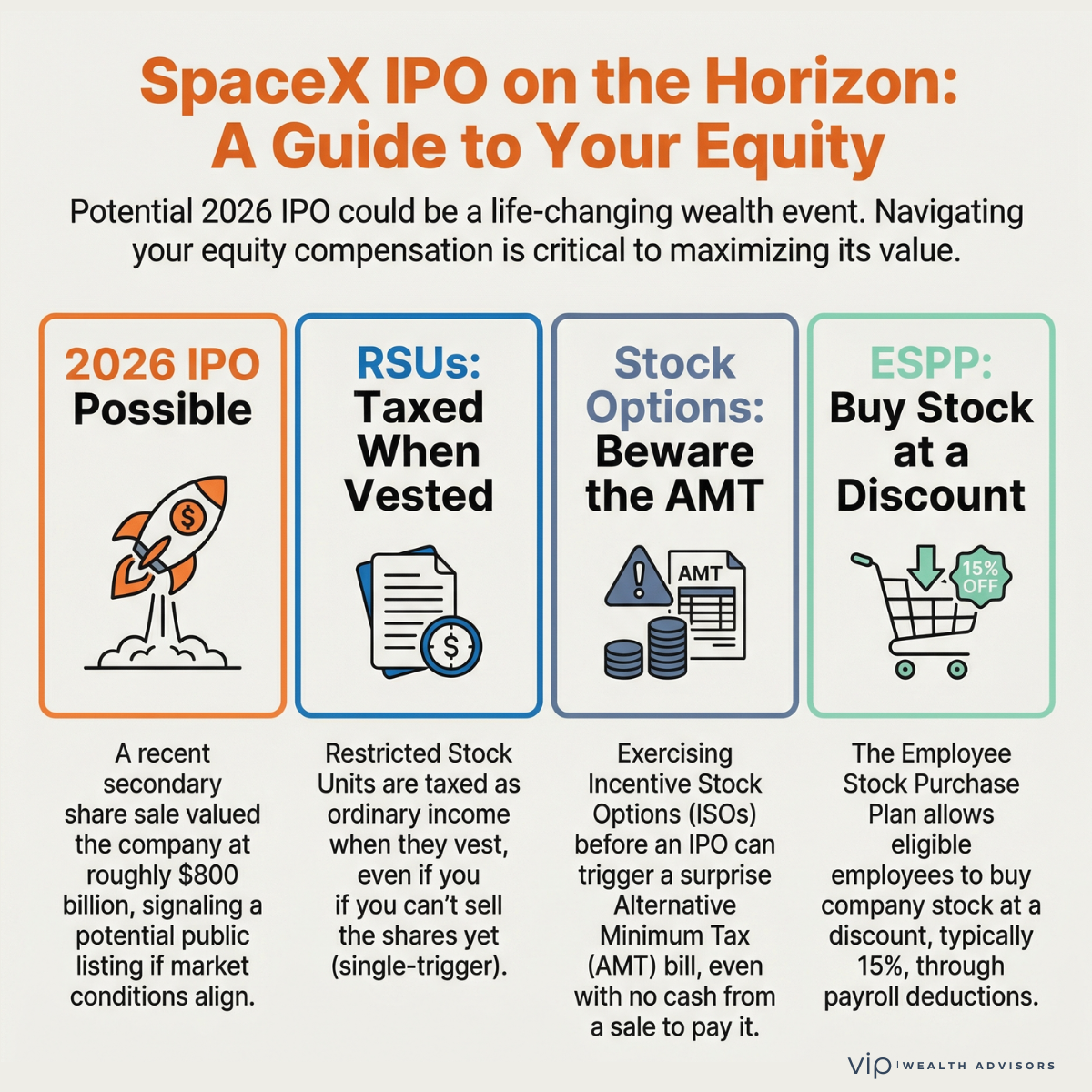
According to recent reporting, SpaceX is actively preparing for a potential public listing in 2026. CFO Bret Johnsen's letter to shareholders signals that the company may pursue an IPO if market conditions align and execution stays strong. A secondary share sale valuing the company at roughly $800 billion has already been launched, which could provide reference pricing ahead of a formal IPO.
While timing and valuation are still uncertain, these developments matter because:
- Historically, private pre-IPO equity could become publicly tradable shares.
- Secondary share pricing helps employees understand the potential market value of their equity.
- IPO readiness can affect a company's liquidity window and tender offer policies.
Bottom line for employees: an IPO that actually happens would be a once-in-a-career wealth event, but it’s not guaranteed, and expectations should be tempered.
2. How SpaceX Uses Equity Compensation
SpaceX’s compensation philosophy has long been to trade relatively lower cash salaries for rich equity stakes, especially for engineers and mission-critical talent.
Here are the main forms of equity you’re likely to encounter:
a. Restricted Stock Units (RSUs)
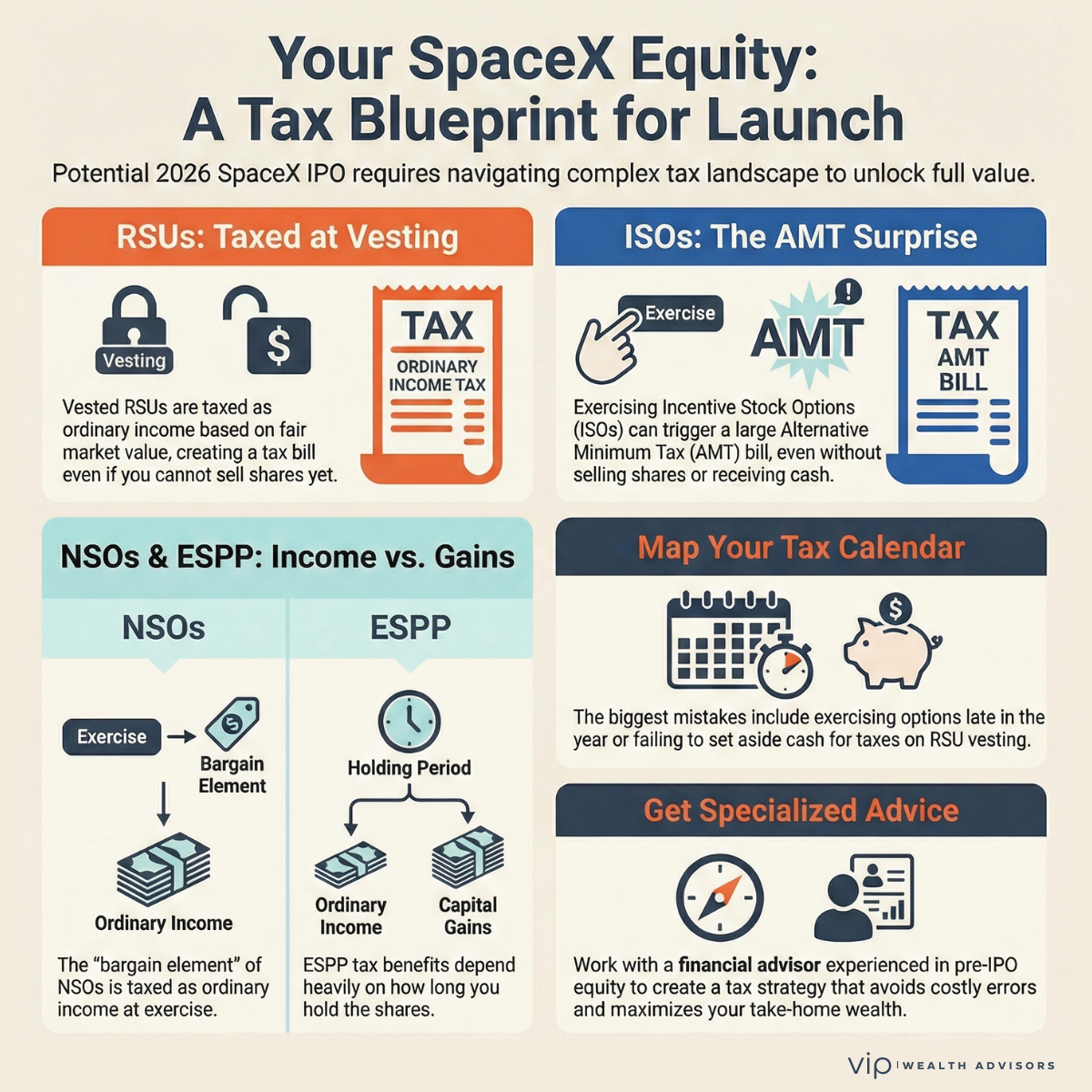
RSUs are perhaps the most common form of equity at SpaceX today. They are grants of company stock that don’t become real shares until they vest, typically contingent on continued employment.
Here's what to know:
- RSUs vest gradually (often over 3–5 years) with a set schedule.
- When they vest, each share is taxed as ordinary income at its current fair market value.
- After vesting, you own the shares and can sell them when a market or tender offer opens.
Since RSUs create taxable income at vest, aligning vesting events with liquidity windows (like tender offers or IPO) matters to avoid holding shares you can’t sell but have already paid tax on.
b. Stock Options (ISOs and NSOs)
SpaceX has historically granted both Incentive Stock Options (ISOs) and Non-Qualified Stock Options (NSOs), though the prevalence of new option grants may vary over time.
ISOs
- Provide the right to buy company stock at a set strike price.
- If you follow strict holding rules, gains can qualify as long-term capital gains instead of ordinary income.
- However, if you exercise before IPO at a low valuation, you may trigger Alternative Minimum Tax (AMT) — a complex tax calculation that can surprise employees.
NSOs
- More straightforward: the difference between the exercise price and the fair market value is taxed as ordinary income when you exercise.
- After exercise, future gains are capital gains upon sale.
Timing exercises can be critical. Pre-IPO exercise of ISOs might reduce the tax burden if done when the FMV is low, but it carries the risk of cash flow issues and AMT exposure.
c. Employee Stock Purchase Plan (ESPP)
SpaceX’s ESPP allows eligible employees to buy company stock at a discount (typically 15%) using payroll deductions.
- ESPP shares accumulate over six-month offering periods.
- If you buy at a discount and hold until favorable tax treatment criteria are met after IPO, you can reap significant tax benefits.
Qualified ESPP sales have special tax treatment if you hold shares long enough — but the details matter, and rushing into selling can trigger ordinary income taxation. Careful planning enhances outcomes.
3. Liquidity Before IPO — Secondary Offers and Buybacks
One crucial reality at SpaceX is that you generally cannot sell private company stock freely until there’s a public market or the company authorizes a liquidity event. That’s because SpaceX, like most private companies, controls share transfers.
To address this, SpaceX has periodically offered secondary share sales and tender offers, enabling employees to sell some of their vested equity before an IPO.
Examples include:
- Semiannual tender offers with caps on how much you can sell.
- Allocations that guarantee a minimum number of shares but allow requests for more.
- Opportunities to sell at prices linked to internal valuations.
Participation in secondary offers can be a rare chance to realize some gains without waiting for an IPO, but they are limited and competitive. Having a strategy for whether and when to sell is essential.
4. Tax Planning: What Most Employees Underestimate
A common theme in equity compensation is the tax complexity it entails. Whether you’re vesting RSUs, exercising stock options, or selling ESPP shares, different events trigger different types of taxes at different times.
Here is a snapshot:
| Equity Event | When Tax Is Triggered | Type of Tax | Common Employee Mistake |
|---|---|---|---|
| RSU Vesting | At vest date | Ordinary income (W-2) | Owing tax on illiquid shares with insufficient withholding |
| NSO Exercise | At exercise | Ordinary income on spread | Exercising without cash planning or bracket awareness |
| ISO Exercise | Year of exercise (AMT) | Potential AMT liability | Triggering AMT without understanding timing or recovery |
| ESPP Sale | At sale | Ordinary income + capital gains (depends on holding period) | Selling immediately and losing favorable tax treatment |
Note: The interaction between these events and your total income determines your true after-tax outcome.
Map out a tax calendar, ideally with a professional advisor experienced in pre-IPO equity.
5. Concentration Risk: How to Manage Equity Weighting
Many SpaceX employees have an outsized portion of their net worth tied to company equity. This concentration can be thrilling when valuations rise … and terrifying when markets wobble.
Why this matters:
- Your career success, emotional well-being, and financial future can all be linked to SpaceX’s stock price.
- After an IPO, market volatility can make your net worth swing daily.
Diversify over time. As soon as tax-efficient opportunities arise, consider selling portions of what you can (via tender offers or an IPO) and redistributing the proceeds into diversified holdings.
6. Restrictions to Know — Pre and Post Exit
Even vested equity comes with rules:
- SpaceX can reportedly prohibit you from participating in tender offers under certain conditions (e.g., if you are accused of misconduct) and may have the right to repurchase shares after you leave.
- Private transfer restrictions mean you cannot freely sell your equity without company approval.
Understanding the stock plan documents and how SpaceX's company bylaws affect your rights is just as important as knowing your vesting schedule.
7. IPO Roadmap — Practical Next Steps for Employees
As SpaceX’s possible IPO draws nearer, employees should consider this checklist:
☑️ Know Your Equity Types and Vesting
Understand exactly what you own — RSUs, ISOs, NSOs, ESPP shares — and when they vest.
☑️ Build a Tax Strategy
Work with a tax pro who deeply understands AMT, capital gains, and pre-IPO equity.
☑️ Monitor Liquidity Events
Track tender offers and secondary sales and be ready to act fast.
☑️ Diversify
Have a plan to responsibly reduce concentration risk once liquidity arises.
☑️ Read the Fine Print
Review your stock plan and award agreements to fully understand the restrictions and repurchase rights.
From Launch Pad to Legacy
SpaceX’s potential IPO in 2026 could be a transformational event for employees who have weathered the long march from private valuations to possible public markets. But turning paper wealth into lasting financial security takes strategy, tax foresight, and disciplined planning long before the first day of trading.
If you approach this moment with clear goals and smart preparation, the stars may align for more than just missions to orbit.
SpaceX IPO & Equity Compensation: Common Questions Employees Are Asking
Will SpaceX actually go public in 2026?
SpaceX has not formally announced an IPO date, but multiple reports and internal signals suggest that a 2026 public offering is increasingly plausible. Recent secondary share sales, rising internal valuations, and leadership commentary indicate the company is moving toward IPO-readiness, though the timing will ultimately depend on market conditions and strategic priorities.
Employees should plan as if an IPO could happen in 2026, without assuming it is guaranteed.
What types of equity compensation do SpaceX employees receive?
Most SpaceX employees receive a combination of:
- Restricted Stock Units (RSUs)
- Incentive Stock Options (ISOs)
- Non-Qualified Stock Options (NSOs)
- In some cases, participation in an Employee Stock Purchase Plan (ESPP)
The exact mix depends on role, seniority, hire date, and compensation band.
Are SpaceX RSUs single-trigger or double-trigger?
SpaceX RSUs are generally single-trigger, meaning they vest based on continued employment rather than an IPO or acquisition. Once vested, they are taxable even if there is no liquidity.
This is a critical planning issue because employees can owe taxes on shares they cannot yet sell.
When are SpaceX employees' RSUs taxed?
RSUs are taxed as ordinary income at the time they vest, based on the fair market value of the shares on the vesting date.
This income:
- Appears on your W-2
- Is subject to federal, state, payroll, and Medicare taxes
- Creates tax liability even if the shares are illiquid
Planning insight: Aligning RSU vesting with expected liquidity events can help avoid cash-flow strain.
Does SpaceX grant Incentive Stock Options (ISOs)?
Yes, many SpaceX employees, particularly engineers and early hires, have received ISOs.
ISOs can offer favorable tax treatment, but only if:
- You hold the shares for at least one year after exercise
- AND two years after the grant date
Otherwise, the sale becomes a disqualifying disposition.
Do ISOs trigger AMT for SpaceX employees?
They can. Exercising ISOs before an IPO may trigger Alternative Minimum Tax (AMT) based on the spread between the exercise price and fair market value at exercise.
This surprises many employees because:
- No shares are sold
- No cash is received
- Yet a significant tax bill may still be due
Advanced planning: AMT exposure can sometimes be recovered later through AMT credits, but the timing matters.
What happens to my stock options when SpaceX goes public?
At IPO:
- Vested options typically remain exercisable
- Unvested options continue vesting on schedule
- Lock-up periods usually restrict selling for ~180 days post-IPO
After lock-up expiration, exercised shares can generally be sold on the open market, subject to insider trading rules.
Can SpaceX employees sell shares before the IPO?
Yes, but only through company-approved tender offers or secondary sales.
SpaceX periodically allows employees to sell a portion of vested shares:
- At a company-set price
- With caps on how many shares can be sold
- Subject to eligibility and compliance rules
These events are limited and not guaranteed.
Is there an ESPP at SpaceX?
Some employees may have access to an Employee Stock Purchase Plan (ESPP), allowing them to purchase shares at a discount through payroll deductions.
If structured as a qualified ESPP:
- The discount can be taxed favorably
- Holding periods determine whether gains are ordinary income or capital gains
ESPP planning becomes especially important after IPO when liquidity arrives.
What is the biggest tax mistake SpaceX employees make?
The most common mistakes include:
- Exercising ISOs without understanding AMT
- Exercising ISOs at the end of the calendar year
- Allowing RSUs to vest without setting aside tax reserves, as the normal Federal withholding rate is at the IRS’s supplemental income tax rate of 22%
- Selling too much stock in one year and jumping tax brackets
- Ignoring state tax implications when relocating
Equity compensation magnifies tax outcomes, both good and bad.
How concentrated should my net worth be in SpaceX stock?
There’s no universal rule, but many employees unknowingly end up with 50–80% of their net worth tied to SpaceX, including:
- Salary
- Bonus
- Career risk
- Equity compensation
Post-IPO planning should include a gradual diversification strategy to reduce single-company risk without creating unnecessary tax drag.
What happens to my equity if I leave SpaceX before IPO?
This depends on your equity type:
- RSUs: Unvested RSUs are usually forfeited
- Stock options: You may have a limited window (often 90 days) to exercise vested options
- Shares: May be subject to transfer restrictions or repurchase rights
Leaving without understanding these rules can permanently destroy equity value.
Should I exercise stock options before or after the IPO?
There is no one-size-fits-all answer.
Pre-IPO exercise can:
- Reduce future tax exposure
- Increase capital gains potential
- Increase AMT and cash-flow risk
Post-IPO exercise offers liquidity but often results in higher taxes.
The optimal strategy depends on income, cash reserves, risk tolerance, and time horizon.
How does a SpaceX IPO affect long-term financial planning?
A liquidity event can:
- Accelerate retirement timelines
- Create complex estate planning needs
- Trigger new tax strategies
- Shift focus from accumulation to preservation
Employees who plan early tend to retain far more of their equity wealth.
Should SpaceX employees work with a financial advisor?
If equity compensation represents a meaningful portion of your net worth, working with an advisor who specializes in pre-IPO and tech equity planning can help you:
- Optimize tax outcomes
- Avoid costly mistakes
- Build a long-term diversification plan
- Align wealth with real-life goals
Generic advice rarely works for complex equity situations.
SpaceX equity is high-stakes. Your plan should be, too.
If an IPO or tender offer turns your equity into real money, the biggest risk is making a rushed decision under pressure. Get a clear tax-and-liquidity plan built around your specific grants, vesting schedule, and cash needs.
This call is designed for SpaceX employees navigating RSUs, options, liquidity windows, and concentration risk ahead of a potential IPO.